Source: Beretning om det Sjette ordentlige Synodemøde I Ostlige Distrikt af Synoden for den Norske ev. Luth. Kirke I Amerika 18851. Pages 25 – x.
Location: Roche a Cree, Wisconsin
Dates: June 4 – 10 1885
Speakers
| Missourians | Anti-Missourians |
| H.G. Stub | Friedrich Augustus Schmidt |
| Amund Mikkelsen | Olaus Naess |
| Johannes Bjerk Frich | Rep. Michael Johnson |
| Hans Jakob Grøgaard Krog | Bernt Julius Ingebretsen Muus |
| Johannes Thorbjørnsen Ylvisaker | John N. Fjeld |
| H.A. Preus | Nils Arvesen |
| C.K. Preus | Peter Andreas Rasmussen |
| Helgesen | Rep Ole Halvorsen |
| Prof. Stub | Nils Jørgensen Ellestad |
| Paul Adolf Dietrichson | Ludvig Marinus Biorn |
| Otto Christian Ottesen Hjort | |
| Hans Jacob Grøgaard Krog | |
| Rep Quamme | |
| Marcus Thorsen | |
| Adolf Bredesen |

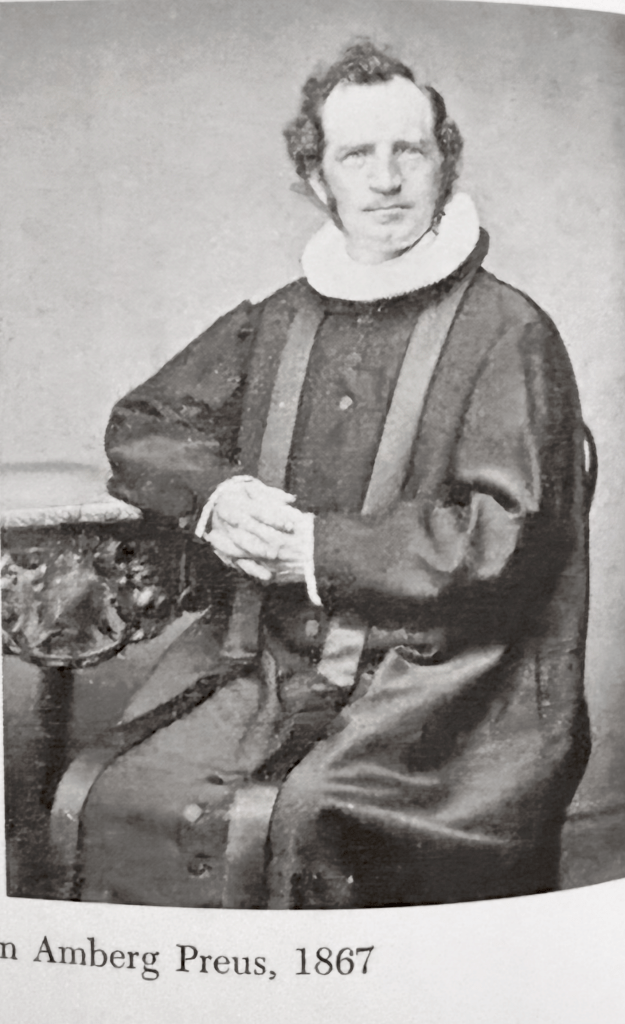
H.A. Preus
After the Chairman of the Synod, Pastor H.A. Preus, had read out his Report, and the manager of the Madison Seminary, Prof. H.G. Stub, had read out his Report, the assembly went over which teaching question they should consider during this meeting.
Pastor Frich: I think we should first come to terms with what we really agree on. We can not expect much from proposals that come from just one side. All members of the Peace Committee agreed on the 17 Theses.
If the same spirit which animated the Peace Committee also animates this assembly, then much will be gained by the discussion of these theses. If we come to a better understanding of these essentials in the teachings, many other bad things will be easier to deal with.
Professor Schmidt: If I could believe that a discussion on these theses were suitable to bring us to peace and agreement, then I would go for them. But it must be a misunderstanding with the agreement we have come to before. If we consider the Confession, we do not have to start with Number 1, but with Number 2, “Concerning the Call.”
I consider the Confession better as a means of feeling our way forward in this matter. I suggest the Confession, which almost exclusively contains testimonies of the Fathers.
Pastor H. A. Preus:1 I will not agree to make a new confession; we do not need more confessions, the ones we have are good enough. According to the Constitution of the Synod, we can not adopt new confessions. If what we disagree with emerges in some way, then it does not depend so much on what is used as a basis for discussions. In addition, the theses of the Peace Committee are far more appropriate. We have found that in the Confession the main point of the controversy is overlooked. One therefore had to go outside the Confession to get a grip on this. These theses are the fruit of several meetings’ negotiation. Out of love for the truth, they have negotiated with each other and put forward what they have agreed on, as far as they have come. Never in a meeting have we come so far as in Eau Claire. If the Synod thinks that the time has come for shooting, then the Peace Theses are not suitable as a basis for discussions; but if one still hopes for agreement, then there is no other sensible choice to make.
Pastor Næss: I hope that everyone’s wish and prayer to God is that we must agree. If we have this in mind, then we will choose the one that we can best agree on. Something is not good because it has taken a lot of work to get it done. How far did the agreement reached in Eau Claire go! After this they wrote against these theses from East and West, in German and in Norwegian. Attempts have since been made to bridge the gap; but they have not been fully successful. One will not vote for new confessions, it is said. It hurts me to call the old truths a new Confession. I will reluctantly believe that on the other side they believe such ugly things as the Calvinists do; but we have been accused of synergism, so let’s see how thick and fat we are.2 I could rather have expected that Preus and Andre would have come up with his Accounting: it must also be a more detailed explanation of the 17 Theses.
Representative Michael Johnson: It’s a nice name to call these theses “Peace Theses,” but they have created unrest in the Committee. Koren understands them in one way, and Bøckman3 in another. Therefore, it is best that we now leave these theses.
Pastor Mikkelsen: Here are two suggestions, the 17 Theses and the Confession. I could suggest An Accounting, but I will not do it; not because I think there is falsehood in it, or that we are defeated if we debate it; but I thought we could more easily attain each other’s meaning with these theses. Next, the 17 Theses contain a certain truth; The Confession, on the other hand, consists of detached quotations from the ancients, and the authors are unknown to us. Finally, there are lessons which have not been revealed in this Confession, probably because the authors themselves were unaware of them.
Professor Stub: Do you intend to reach an agreement through calm deliberation, or do you intend to establish a confession?
It should be the intention of this meeting to agree if it is possible to agree, or at least to prevent division. We still feel that we want to do the utmost; therefore this is the great question: how are we to proceed? We should therefore choose something that wins everyone’s sympathy. We should choose something that is the fruit of a previous mature consideration. These Theses of Peace are not just the old ones from Eau Claire, but five new ones in which we have taken into account things of a difficult nature. These Theses of Peace are of a different nature than the Confession. We should not give the appearance that we come together in Synod meetings to make new confessions, to establish new dogmas. One will demand assent to this Confession, the Theses of Peace, on the other hand, do not come as a confession to be accepted.
If we are to make a new confession here, I will protest. We have no right to do that. The theses must therefore be a guide for us. They show us how far we agree. The most reasonable, fairest, and best suggestion, then, is to use these 17 Theses.
Pastor Frich: I regret that none of the members of the Peace Committee, on the other hand, are present. One can suggest, the Confession, others could suggest An Accounting, and then keep arguing about which of these proposals could get the most votes for itself. What we were about to do in the Peace Committee was to get to the points on which it was thought there was some significant disagreement. A matter of conscience for both parties had to be that one had not entered into Calvinistic or synergistic opinions. We loved Eau Claire; it went well there. But then they screamed and wrote soon from one, soon from another side about these theses, which we are accused of. It so happened to Pastor Bøckman that he lost his enthusiasm for these movements because of an article by Pastor Koren. But at our last meeting in Zumbrota he was satisfied and was so pleased with the result we came to that he said he could not describe it.
Pastor Krog: (I) Will also vote for the 17 Theses. If it is our intention to prevent division, then we must be convinced that on neither side are fundamental delusions celebrated. But if we wholeheartedly agree with these theses, we have not fallen into fundamental delusions. It is important for us to have a guide for the negotiations. This Confession is merely from one side; but the theses are from both sides. As for peace and unrest in the committee, Professor Mohn said that the members were so cordially pleased when they left the last meeting that: “If these theses were agreed to, there would be no division.”
Pastor H. A. Preus: In Eau Claire I was very glad that excellent men from both sides had come so far towards agreement. At the beginning of the conference I said explicitly that there were expressions I did not like, so that if these theses were to be expressions of a particular doctrine, then they were not a perfect work. But if we are now so fundamentally different that we must separate, then it is not a matter of expression, but much more of the meaning of words and expressions.
When these negotiations came out and were read here and in Germany, it was not said that our meaning and intention with these Theses were understood. It was not decided that now, after the adoption of these Theses, it was necessary to put an end to the whole controversy. The main truths that are disputed are contained in the 17 Theses, and if we agree on what is in them, then we do not have to separate from each other.
Professor Ylvisaker: When Næss says that his side is accused of “thick” synergism and would like to get into it, I am very grateful for what has been said. That is also my opinion; but therefore we should just take for granted the 17 Theses.
It is emphasized that the point about stubborn resistance should be the main point of debate. Now, if Pastor Næss wants to get into that, he should vote for us to get into that as soon as possible. We know we are accused of Calvinism; therefore we should use the 17 Theses, in particular the Supplement will be of help to us. Michael Johnson says they created unrest; if it is so, well then, they may lie under this judgment. I would like to point out that the Peace Committee has been together for a new meeting, of which it has probably been said here that they have unfortunately moved further apart; but we hear the Committee’s own members testify to the contrary. These Additional Theses were now to deal more precisely with the matters in which they disagreed in Eau Claire and Minneapolis, and on these Five Theses they have agreed. It is not a great encouragement for the Peace Committee to continue negotiations when they do not like their work so much that they want to negotiate about it.
Pastor Muus: It amazes me to hear the President recount that the Committee has decided that these theses should be submitted to the Synod. It seems as if the Committee wanted the Synod to take these as the subject of negotiation. But it was not possible for Frich to persuade Mohn and Bøckman to propose them for consideration, but rather to propose them for reading to the Synod.
Pastor Frich interrupts: Will Muus explain why they would not agree to that?
Pastor Muus: I can not see into the hearts, but I heard what one said, namely, that he did not know if they were fit to be submitted to the Synod.
I hear Preus say that he will not help to make a new Confession; but last year he sent out a new confession into the world with his name signed on it, namely, An Accounting. The one who signs that Accounting is a false Teacher; we should not amaze people with claims about new Symbols, but mutually ask each other what we think about this and that. We should here consider a major issue in the Christian Faith, but not what are fine philosophical questions, for example, what is Synergism? Some of this can be rough stuff; but where the branches are so fine, one abuses one’s time by debating about it. In an assembly like this, it is useless to go into this. A major issue in the Christian Faith is this for example: Can a man repent? Does not his conversion depend in the least on man himself?
Pastor C. K. Preus: I am not very learned to say which theses are the best; but I think that what skillful men on both sides have agreed upon after extensive negotiations must be more expedient than that which comes only from one side. These Theses of Peace, however, should not be objected to from the other side; for Professor Schmidt has, however, repeatedly written that in these theses we had gone too far and admitted too much.
Recorder: Pastor Frich disputed the accuracy of Muus’s information. The committee unanimously decided to submit the theses to the Synod, and as a reason against expressly proposing them for consideration, it was especially argued that this was superfluous when we submitted them to the Synod.
+++++++
In the referendum, it was now decided by 63 to 59 votes to base the Negotiations on the Confession.
It was then decided to start with Chapter II, which is about
The Call
“Still we confess as the Doctrine of the Word of God: a) what Dr. E. Pontoppidan says in Question 478 of Truth unto Godliness, which reads: ‘What is the Call of God? That by his Word He touches the hearts of men, by the gospel in particular reveals to them his grace, offers it earnestly, and at the same time gives them power to accept it. 2 Tim. 1:9’.”
Pastor Mikkelsen wanted the authors of the movement to develop the meaning of this.
The chairman stated that the author was actually Dr. Erik Pontoppidan.
Professor Stub: I do not know whether it is necessary here to go into the theses itself, for it is fair and correct; but on the contrary there is something which will give rise to discussion. The theses itself contains our explanation.
Professor Schmidt: It is, after all, in the Order that the other party, when it comes to something that it thinks is ambiguous, then asks us what we mean by that.
God’s Call must not just be merciful and leave it to us if we can accept it on our own. The Call must also be a message of power so that those called can accept the grace offered. For otherwise we are not helped, because a redemption that is not accepted cannot benefit us, and we by nature do not have the ability to accept it. I Cor. 2:14: “But the natural man does not receive the things of the Spirit of God, for they are foolishness to him; nor can he know them, because they are spiritually discerned.”
God must not only teach, but also give power to receive, otherwise there will be no reception. He earnestly offers his grace “and at once gives power to accept it.” This does not mean, however, that they get all the power from the first moment, but it goes according to the order of salvation step by step.
Pastor Helgesen: That we all agree on the words of this quotation is obvious; but I think the other party has abused some of these words. What is meant by “giving” strength to accept the grace?
Does God bring power into man before conversion? I mean no! How then does one understand this expression?
Pastor H. A. Preus: I just wanted to ask what is meant by the Word being “power-announcing.” In Pontoppidan’s words, I wholeheartedly agree. But when it is said to “communicate powers,” does it mean that it happens at the first moment that man hears the Word? To e.g. a wicked man who comes here to the church for the first time and hears the Word of God, does he then also gain in himself the power to believe and repent? Or is this power in the Word such that there is every reason for him to become a convert and a believer?
Professor Schmidt: I think I have already answered this. When he first heard the Gospel, he would first have to be awakened by the Law before there could be repentance. I mean, there is full force in the Word, and it then depends on whether man receives or not. It is God’s blissful calling that has come to the sinner.
Professor Ylvisaker: This question in Pontoppidan is important for two reasons. First, here it is averted that God should be biased in his calling, and it is emphasized instead that he comes with the same powerful call and with the same will to convert all people to whom he comes. He comes with the same grace to them and offers it in the same way and also gives power to accept the grace, and he does so through the Word. When the Word comes and tells us about the grace of Christ, it also comes with power. The Word is a bearer of this power.
There is also another Calvinist heresy, Pontoppidan here wants to ward off,—namely a forced conversion. So God does not force it into man, that he must now also (convert).
Pontoppidan asks, Question 485: “What is the real difference between human knowledge and divine enlightenment?” Answer: “Human knowledge can be acquired by human ingenuity and diligence, while standing against the power of God’s Word; it is only the faculty of the brain and merely a historical knowledge, and therefore allows man to remain in his evil.
The divine enlightenment is effected by the same word of God by the Holy Spirit, which then finds room in the soul; it fills the heart, gives a living experience, and begins to take away the defiance of the will.”
He teaches here both the generality of grace for all and the averting of a forced conversion. The word “notify” is ambiguous and should not be used in this context; if it is used, it must be objective, in the same sense as giving. It can also be misunderstood, and therefore one should be careful in its use.
Professor Schmidt: I say that the Word has a communicative ability; but whether it comes to communicative action depends on whether man resists or does not receive or not. There is no difference in God’s calling, it is the same for everyone, to whom it comes. The difference in effect therefore depends on man’s different relationship to it. God will give to everyone all the necessary power through the calling.
Pastor C.K. Preus: I want to ask a question. I find that Schmidt in the Synodal Report for 1884 page 33 says: “All necessary power is present, not in man, for he is by nature dead to all goodness—wicked—but in the Word, and there man is brought so close that God from His side does not do more or use more force to work conversion in anyone, no, here He is sufficient for all.” Here it is said, then, that this power is not “in the man.”
Pastor Muus, on the other hand, says in Lutheran Testimony for 1884, Page 471: “I will confine myself to admitting that I certainly believe that man can repent when God calls on him by his Word, and that he has the ability to it in himself and not from outside.” So “in himself” and not “from outside,” while Schmidt says “not in Man,” but “in the Word.”
How, then, is this to be rhymed together? Will Professor Schmidt ask if it is not synergism when it is taught that before his rebirth man receives and has in him a power with which he works for his conversion? For this, however, must be Muus’ interest with his doctrine of such an ability in man.
Pastor Fjeld: I understand it so that the Call, when it comes to man, is also powerful and touches man’s heart. The ability that is in me is worked by the Holy Spirit by the Word.
Professor Stub: From the present theorem on the Call, namely question 478 in Pontoppidan’s Truth unto Godliness, it appears that it is God who stands calling directly before man, it is man as person, that is, God is calling directly opposite the human soul or heart, or, if we will, God is equal to man’s mind, will, and conscience. Now the human mind, will, and conscience are naturally in man. It is not something that is outside of man. It is, therefore, these faculties of the soul which are subject to the influence of God, and this influence is not external, but one which takes place in a hidden way in man, namely, by the Word, the Law, and the Gospel. Now Pontoppidan says that this influence takes place in such a way that God “touches the hearts of men.” God therefore does not leave these powers of the soul, understanding, will and conscience in undisturbed calm; but God draws near to them through his Word. Thus, through the Law, he seeks to convince man that he is a sinner, that he is in an unhappy state and in need of salvation, and without God touching him in this way, man would lie in a false peace. Now the answer goes on to say: “…reveals and offers them his grace through the Gospel, and gives them strength to receive this grace.” The Gospel is therefore what especially comes into consideration. God thus comes close to the minds, wills and consciences of men or to the hearts of men and reveals to them his grace. He shows that there is salvation. But the Gospel is not just a story that there is salvation, but this same Gospel, which appears before the mind, will and conscience of men as a story, as a revelation of God’s grace, also carries within it all the glorious gifts which it reports. It brings salvation close to, but not only that, it is also a living, life-giving word; it is of the nature and character that it carries with it—inseparably attached to it—the power to receive the gift which it brings; it breaks the resistance to the grace of God.
That is, wherever God turns with his calling, there we say that man as a person is the object of this calling of God. God works on the mind to enlighten it, on the will to bend it, on the conscience to awaken it. But in this phrase only the call of God is spoken of, and one must not mix in anything from the human side. Here it is not said that something has yet entered the heart. Man has the ability to resist on every point, as Pontoppidan also says. So, wherever God begins to work, man has it in his power to resist. On the other hand, there is no question here that any force, let alone any life force, has entered the human being. By this work of God, which is not an external influence, but an influence which takes place within, the Holy Spirit stands directly opposite the individual abilities and knocks, but the Holy Spirit has not yet entered, and thus there is no announcement of a new force. Pontoppidan teaches here no announcement of a new power. During this question about the Call, he refers to 2 Timothy 1:9: “Who has saved us and called us with a holy calling, not according to our works, but according to His own purpose and grace which was given to us in Christ Jesus before time began.”
Here the words are used: “And the grace which is given to us from everlasting,” and it is clear that the grace is given on the basis of Christ from eternity. The grace is given, it exists, and when God lets his Gospel be preached, he comes with the grace which is given to all, but which has not yet entered into all; it only happens by faith.
Pastor Muus: I am glad that we have seen under consideration a point which is a main point in the practical life of a priest, and which it is necessary for everyone to be aware of, and which anyone who has a little spiritual wisdom can understand. This case has a history which I think is somewhat instructive and which I shall briefly touch on. During a church council meeting in Minneapolis, the other clerical members of the church council declared that it is not very easy for the unconverted to want to repent when God’s Call comes to him. Then there was a clergy conference in Decorah; there they came to the conclusion that it is right teaching that the unconverted can repent; that is, not only can will it, but can also do it, and it was added that it is a false teaching that there was some power from God that had come into the unconverted before the conversion, which they could use. When we now come to Pontoppidan, who straightforward teaches that God gives the converted—by the Gospel, wherever it is preached—a power to accept this Gospel, then it is a little difficult to reconcile these things. When one declares himself a Pontoppidan here, it would be very gratifying if one really agreed with Pontoppidan’s teaching. Then there was no essential dissension between us in this piece, then the Root of Evil was drawn out; but now we have heard today that when they are ready to agree to Pontoppidan, they will agree to its sound, but not to the meaning which these words have among men.
With regard to Pastor Helgesen’s remark that it was wrong for God to pour out certain powers, I will only refer to what Pontoppidan says, that God gives the unconverted power to accept his grace, and it lies in this that God gives a power that he can use if he wants to accomplish what he was given it for.
Professor Ylvisaker says that this power comes to man in an objective way, so that it does not enter man. What does it mean that a power comes to me that does not enter me, that is not in organic connection with me? What good is that power to me? I’ll give an example 1. A bear comes and attacks my son. I give him gunpowder and a gun. They are powers that he must use; but he does not understand how to use these powers. What use are they to him then? And if I, as his father, fear for his life and tell him that there are forces here that are only objectively outside of him, then I am only mocking him. And when God tells us that we are under the power of the Devil, and then he gives us strength to resist, but notabene does not give us that strength in such a way that we can use it, it is just objectively outside of us:—I understand nothing but that the gentleman had to make fun of us. Take another example: There is a poor man who is starving. I have food to give him; but he is paralyzed and cannot receive it. Now if I could use an electric battery on him that could set his arms in motion, but instead I put this electric force objectively outside of him: what use would it then be of to him? It must have been making fun of the poor man. And those who teach that God gives all men a power objectively outside of them, a power which they cannot use, they have a different conception of the highest being than I do.
Pastor Frich: What Muus said at the end is good enough, if we only had human reason to follow in the matter of salvation, and if the Word of God taught nothing else, namely, that man is spiritually dead, and that he is in a state in which he neither can use or knows how to use the spiritual powers, which is also what Pontoppidan teaches in Truth unto Godliness. However, we have not come to the actual point of contention in the present matter of Pontoppidan. We all agree on that. But in this clause there is no further discussion of how this power is transferred to sinners. Now we in the Peace Committee have tried to explain, on the one hand, God’s work on the sinner, and what meaning it has, namely in that proposition:
“When God comes to a man with his Word and call of grace, this happens so that man may repent, and this Word and call of grace always brings its full force unto man’s repentance, and this will surely enter where man does not stubbornly resist the work of grace.” And in Note 2: “By the obstinate resistance, which, as long as it lasts, always makes conversion impossible, we understand that man, when he finds himself under the pressure of grace, clings to his resistance to grace despite the fact that he could then refrain from this Resistance not by his own power or by an inherent life force bestowed by God, but only by the power of the action of God’s grace.” And in proposition 4: “With this effect, God is present with all the people to whom He comes with his Word and Call of Grace, and thus makes it equally possible for all of them to be freed from that opposition.” So that there is no difference, as far as the calling is concerned, with regard to any human being. And in proposition 5 we say: “Before conversion has taken place, there is no inherent life force for good or to give up resistance to God in the person who is the object of the Spirit’s preparatory work.”
And so, as a further explanation of these things, we have adopted these additional propositions, of which proposition 1 reads as follows: “All that must be done for or produced in man, in order for him to be converted, and which it is impossible for man himself to do, God does by his word and call of grace;” and proposition 2: “When we say that the unregenerate, when he finds himself under the pressure of grace and in spite of this, insists on his resistance, can dispense with this resistance, then we mean that he can dispense with it then and not only when he really dispenses with it. There is therefore, while he is under the pressure of grace, no difference between the time when he can let this be. We reject the doctrine that man could only avoid stubborn resistance when he really avoids it.”
We therefore say that it is real and true that man can do this, but he can only do it by virtue of the effect of God’s grace, it is God’s work on him. That man, on the other hand, sets himself against it, is due to something in himself.
And so we say in proposition 5: “God does not give man before rebirth a power which he now possesses as his own, organically united with it, so that he has free will and ability to use it, a power with which he now in full freedom of choice he himself can decide on his conversion. God does not give man such a power until the very moment in which he regenerates him.”
There (in the Peace Committee) we all agreed in rejecting what Muus has put forward with regard to this matter, and in rejecting the theorem which Muus dictated to us in contrast to our proposition 5, namely: “Man, who is called by God, is under the influence of God’s preparatory grace and then receives from God’s grace abilities and powers, which he then has and can use with free will and the disposition to use them, abilities and powers with which he can decide for himself with full freedom of choice to repent to God.” This is directed against the clear teaching of the Word of God and Pontoppidan.
Professor Schmidt: The main issue here in Pontoppidan’s definition of the Call is what God does for his part directly opposite man, that he not only comes to man with a grace that he offers at all, but does not by the same call help man to be able to accept; for what avails me a redemption which I cannot accept? For if I cannot accept it and am not put in a position to do so, then I am just as helpless as if Christ did not exist.
Now it is not the case that we learn that as soon as the call for mercy is heard by a person, he is placed at the point in the Order of Salvation that he can immediately believe in Christ. I learn that it must go according to the Order of Salvation. No one can thus come to Christ except by confession of sin, and this is done by the Law; but it is nevertheless true that the word he hears is a call to eternal life, he receives a call to all the benefits of grace; as when I offer a boy to enter the school in Decorah, then the invitation applies to go through all the school’s classes. As it says in Acts 13:46: “It was necessary that the word of God should be spoken to you first; but since you reject it, and judge yourselves unworthy of everlasting life, behold, we turn to the Gentiles.”
So, that which is the goal, they despised. The entire Order of Salvation is connected in such a way that God gives man the ability to go through all the degrees of grace, if he allows himself to be brought through them. In that sense, he objectively gets it all; but he must let himself be told the whole thing.
With regard to Frich’s statements about our rational conclusions, I would say that the Scriptures teach me that the dead man has already reached the stage under the preparatory grace, that he can do something by virtue of the Call. What decides this for me is Ezekiel 12:2, which reads as follows: “Son of man, you dwell in the midst of a rebellious house, which has eyes to see but does not see, and ears to hear but does not hear; for they are a rebellious house.”
Now I ask: Are these eyes outside of man? What kind of eyes these are is not stated here; but as I read it, they have eyes to see with, and which they can close. God says that, and not Muus or I. There must therefore be in this obstinate house an ability, a power to see and hear with which they do not use; for to have eyes means to have the ability to see. So there must be an ability about them that they don’t use. There are many outside Christianity who know very well what it is about, but they do not use it. The same is the case with another place, Isaiah 5:4: “What more could have been done to My vineyard that I have not done in it? Why then, when I expected it to bring forth good grapes, did it bring forth wild grapes?” Should it bear good grapes without having the ability or strength to do so? Yes, the power was there by the work that God had done with his vineyard; but they did not make use of it. For me, it is not the main question whether one can draw the line between what has entered the human being, or what has not entered; for me the main thing is that I can preach that people can repent, and if they do not, then it is not God’s fault, but their own, that they had not used the ability that they really had through the work of grace.
Pastor Mikkelsen: The main point is that we believe that it is taught on the other side that man is given a power under preparatory grace which he uses even before rebirth and which contributes to his conversion. We have heard this pronounced today, and it is also pronounced by Pastor Waldeland in Lutheran Testimony4 No. 10 for 1882. He says there: “And through the Word, which is a power of God, God communicates the power to the will to be able to act according to the knowledge that God, through the enlightenment of the mind, has given man to recognize from his word.” And so it says on page 179: “But when man listens to the Word with devotion and attention, then the Holy Spirit will work and give what the mind and the will of its own natural powers can neither take nor give. Now does man use the grace that has been given to him by the light received in the mind to see and recognize something necessary for his salvation, which he would not have been able to know without this light given through the word and the spirit, and he uses the power granted by this light to be able to keep still before the Lord and give further and closer attention to his speech, and if he thus allows God to have his work in him, then more and more grace will be given—until the blessed moment arises that he will be reborn. For whoever has, to him shall more be given.”
Here it is taught that there is something that he has already received and that he can use. And again on page 181:
“It is a right to portray the state of the soul in whom contrition or repentance has been wrought by the Spirit of God by the Law, as one that resembles Lazarus in the grave. It must be assumed as a given that the grace of the preparatory spirit works something where the is not reluctantly resisted, and that this grace, by its action, imparts an effective force to the heart. There must then be a power of grace or powers of the spirit, which is both given to the soul, experienced in the soul and applied and used by the soul, before the quickening by faith in Christ enters.”
Here we think there is a transformation. Under the preparatory grace, says Pontoppidan, it is that God touches the human heart, as the scripture shows: “I stand at the door and knock.” Where a change now takes place, so that grace is received, there is a recharging of the heart, and only then do new powers come that man can put to use. That man cannot repent in this way before the rebirth, that he has a power at his disposal, I find this from the following scriptures: Jeremiah 6:10: “To whom shall I speak and give warning, that they may hear? Indeed their ear is uncircumcised, and they cannot give heed. Behold, the word of the Lord is a reproach to them; they have no delight in it.” Here it is shown that these people were in that condition because they despised the Word.
Further, Isaiah 6:9-10: “And He said, “Go, and tell this people: ‘Keep on hearing, but do not understand;
Keep on seeing, but do not perceive.’ “Make the heart of this people dull, And their ears heavy, And shut their eyes; Lest they see with their eyes, And hear with their ears, And understand with their heart, And return and be healed.” Here God says in advance that what the governor will talk to them about will not benefit them.
Further John 12:35-41: “Then Jesus said to them, “A little while longer the light is with you. Walk while you have the light, lest darkness overtake you; he who walks in darkness does not know where he is going. While you have the light, believe in the light, that you may become sons of light.” These things Jesus spoke, and departed, and was hidden from them. But although He had done so many signs before them, they did not believe in Him, that the word of Isaiah the prophet might be fulfilled, which he spoke: “Lord, who has believed our report? And to whom has the arm of the Lord been revealed?” Therefore they could not believe, because Isaiah said again: “He has blinded their eyes and hardened their hearts, Lest they should see with their eyes, Lest they should understand with their hearts and turn, So that I should heal them.” These things Isaiah said when he saw His glory and spoke of Him.”
This is also a case of hardening in the face of God’s Call to grace. Now if they had received a gift in the soul which they could use, then the Scripture could not say this. So it is not true that all people get into their hearts such a power that they can use according to their own will to repent. It is where the work of God’s grace presses the heart that it repents; but not so that there is a communication of power—so that they have half a grace for repentance today, and if they will use it, they may.
I ask, has the power spoken of here come in by force?
Pastor Muus: When things are wrong, it is gratifying that you get the delusion presented as clearly as Mikkelsen has been so kind as to produce here.
This is about what God works in man through the Gospel. Pontoppidan says that he gives us power to receive grace. Now Mikkelsen will refute it with such places as Ezekiel 6 and Ezekiel 12:2. But these places do not belong to my Gospel. They belong to the judgment of those whom God has given grace and power to repent, but who would not use it.
When Mikkelsen talks about the fact that no one has received half a grace, such statements sting my heart. For I am accustomed to believe that:
Today is the time of grace,
today is God to win,
nowwithearnest diligence
his gentle heartyoucan find.
Up! up! to the cry of recovery,
and after Jesus chase,
but soon! that’s my advice.
Nowwhileit’s called: today!5
That when someone scoffs at the fact that we have been given God’s power for repentance, it touches me uncomfortably. We are used to believing that we live in the age of grace and that God does not demand of us things that we cannot do.
What I really wanted to talk about was this: when God comes to the unconverted, he shows him the way of salvation. Man then gains an ability to learn to know the way of salvation, which he did not have before; this ability he can not only repel, but also use, and it depends on his use of this ability whether he advances.
If he uses this faculty, he learns that there is a Law which God requires him to keep, and if he tries to do so, he will learn that he is a sinner who cannot keep it, but must perish. Whether he advances depends on whether he has used this ability in the right way. If he now learns about Christ, then he realizes that he must go to him for salvation. If he now uses this ability that he has received from God, he begins to pray to God for spiritual enlightenment. If he does that, God will lead him on.
Pastor Helgesen: I have previously asked how this should be understood, that God gives power to accept grace, but I have not received any direct, even if indirect, answer to that. I would like to ask if it is a correct view of Muus’s teaching that the call is a calling and that God instills this power in man so that it remains there, so that it is no longer with God, but is away from God and lies in Man, a force like man himself, if he allows himself to be led into the Order of Salvation, which must be man’s business and something with which God has nothing to do. I would like to know if this is really Muus’s opinion; whether it is like when you got a certificate at a reduced price, in which case it depends on the recipient whether he wants to use it or tear it up. I do not understand the Call to mean that any full power comes into the called person, but that God’s Word in the Call comes like a friendly sunbeam that melts the icy heart, so that man himself does not prevent the call from doing its work. But according to Muus, there must be life in the unconverted before regeneration.
Pastor Fjeld: I would like to ask that you do not try to misunderstand each other. When I hear Mikkelsen read scriptures that are exactly the opposite of those that Schmidt read, then there must be a misunderstanding. What Schmidt recited must concern God’s general will of grace, and what Mikkelsen recited clearly applies to those who have reached a different stage, namely during hardening.
I do not want to teach that every man, however wicked he may be, receives such a new power into his heart by the call to grace; for the call to grace can be resisted. I don’t think anyone on my side teaches that way either. Regarding the point of how grace comes into man, I will use the image of the iron pierced by the fire.
God’s Word is like a fire that surrounds us and enters our cold heart. But this is God’s work from first to last.
Professor Stub: I cannot say how amazed I was to hear Professor Schmidt cite Ezekiel 12:2 as the main evidence for the teaching that a new power comes into all people who hear God’s Call.
Now what does Ezekiel say? “Son of man, you dwell in the midst of a rebellious house, which has eyes to see but does not see, and ears to hear but does not hear; for they are a rebellious house.” The prophet thus speaks of the hardened Jews. An exact parallel passage is Isaiah 6:9-10: “And He said, “Go, and tell this people: ‘Keep on hearing, but do not understand; Keep on seeing, but do not perceive.’“Make the heart of this people dull, and their ears heavy, and shut their eyes; lest they see with their eyes, and hear with their ears, and understand with their heart, and return and be healed.” Here, then, the Word’s answer: “Hear diligently!” to the words: “have an ear to hear!” in Ezekiel. And the words: “Look diligently!” corresponds to the words: “have eyes to see with!” in Ezekiel. But in spite of this they neither hear nor see. So what new power is there in these people? It is even clearer from the New Testament (Matthew 13:14), where Jesus himself applies the words of Isaiah to some of his listeners. First, Jesus presents the parable of the four types of soil, and immediately afterwards he says: “And in them the prophecy of Isaiah is fulfilled, which says: ‘Hearing you will hear and shall not understand, and seeing you will see and not perceive;” Jesus had therefore presented the parable of the four types of soil. Did it not carry the Gospel? But what power now came in those to whom Jesus applies Isaiah’s prophecy?
What I wanted to talk about, however, are several of the unfortunate and crazy expressions that can come up during an argument. There we have e.g. the term “announce.” Every one knows that the proposition was once made that “the Gospel gives, bestows, and communicates the remission of sins to all, whether they believe or not.” With this one would only claim that the Gospel is the same in its content and essence for everyone, and that God truly offers the forgiveness of sins as a gift, destined for everyone. But the expression “communicate” is wrong, since it will generally be perceived as if not only God gave the gift, but as if men also thereby became partakers of the forgiveness of sins, and then it would be a false teaching to say that the forgiveness of sins was communicated all. It is the same with the term “sheep.” Pastor Muus once established the principle that the wicked will receive the forgiveness of sins. In doing so, of course, he only wanted to claim that the forgiveness of sins was truly granted and given to everyone. But the term “sheep” is misleading, since according to common parlance it will be set up not only as an offer that is given, but also as if the assumption or reception of the offer is contained in it. And when the term “sheep” is used in this sense, of course the previously mentioned sentence is incorrect.
This is quite how it is with these expressions “announce” and “get” in the case before us. If one wants to include in the expression “giving at the same time the power to receive grace” in Pontoppidan, the fact that a new power is brought into men, they are thus informed that they all have and possess a power in them as something that is united with them, then it is a false doctrine. Because thereby is taught irresistible grace and forced conversion.
However, I find that someone from the other side has written as follows: “The Missourians (the Norwegians) would also like to agree with this answer to Pontoppidan’s question 478; but they then explain that Pontoppidan does not mean the same thing by ‘gives’ as ‘announces.’” From this it appears that the person in question puts into the order “announce,” that not only from God’s side is a new power given, but that the power is also driven into men.
I find that Pastor Muus has in a series of propositions under the name “Peace” the following proposition: “The Word of God always brings the unconverted grace, power and the ability to repent, so that the unconverted, who, before he was called, could not repent, after he is called, may repent.” Here, therefore, Pastor Muus first quite correctly uses the expression: “brings grace, power and the ability to repent.” But in contrast it says: “We reject the teaching that not all the unregenerate, who are called by God, receive from him grace, power and the ability to repent.”
Here, then, Pastor Muus has allowed himself to use the word “get” instead of the word “bring.” But in the word “get” lies, according to common parlance, not only a giving, but also a receiving. But, if we include the expression “few” here with it, then the expression “few” is wrong and contains the doctrine of a forced conversion.
Quite so it is with the expression “can.” Pastor Muus knows the church’s history so well that he knows that the term “can” is a disputed, misunderstood term. When therefore Pastor Muus says that the main question is whether an unconverted person can repent when God calls him, then it is a misunderstanding. In one respect it is quite right to say that the unconverted can repent when God calls him. If this means that when God calls the unconverted, then there is a full opportunity for them all, that God is then present with all his grace and gifts, that God moves close to everyone and works on the reason, will and conscience so that they repent, so that all responsibility rests on man, and that there will be no excuse on the Great Day, then it is quite right. But if by the word “can” you mean that the unconverted man, whether he wants to or not, gets a new power in him, that God, as it were, puts a new power into man, which men themselves must now use, so that there are thus two factors in conversion, God and man, then the expression is false and carries in it a false teaching.
Professor Schmidt: Ezekiel 12:2 says about the stubborn that they have eyes to see and yet do not see. Here, we are therefore talking about how they relate to the ability they have and which they do not use. here we are obviously not talking about the external, corporeal eyes, but about an ability in them that they do not use, which is why the sentence of hardening is pronounced on them. When God stands at the door and knocks, he will not break the door down by force, but he asks permission to enter, and if anyone opens the door, it says, he will enter. Now they probably say that it is God who opens the door, but both of these places must be left standing, because when God opens the door, both God and man come into consideration.
With regard to the saint’s statements,6 I have not said that there is a power cut off from God, nor that God has nothing to do with man being led into the Order of Salvation, nor that the whole conversion lies in the hands of man when he is called; for it is the Holy Spirit that pervades the entire Order of Salvation. From Matthew 23, 37: “how often I would have gathered your children…and you would not,” I conclude that they could have allowed themselves to be gathered, but would not.
When God says in Proverbs chapter 1:29 that those whom he called (v. 24) “hated knowledge and did not choose the fear of the Lord,” then he reproaches them that they did not do something that they both should and could have done by virtue of his Call to mercy. They both ought to have and might have chosen the fear of the Lord instead of letting all his counsel fail. But because they did not do what they might have done, they must suffer punishment. In what way they could do this is a second question. I think it is like a seed that grows. If someone carries the Word in his heart and lets this sprout of knowledge go forward with the power that the Word has in itself, and he stays with it until the end, then he becomes saved. By this I do not want to say that man has something in himself with which he can become saved, just as a seed placed here on the table will not be able to germinate, but it nevertheless has the power within itself to be able to germinate.
Pastor H.A. Preus: I asked Schmidt the question whether he believed that all men, without exception, to whom God offers his grace through the Gospel, are immediately empowered to accept this grace. Schmidt sidestepped my question by replying that he did not mean to claim that everyone immediately gained all possible power. We can agree on that; nor is it the case with him who is born again. But that was not an answer to my question. However, Schmidt expressed himself in such a way that I think I have reason to believe that he wants to interpret these words of Pontoppidan in such a way that everyone who hears the Word will thereby also gain such new strength in his heart; however, I am not sure about that. Such a statement was made that it was man who let the seed of the Word germinate. I believe that it is God who puts the seed in the bottom of the heart, who also lets it sprout.
We have heard that there are statements by Muus and Schmidt which are diametrically opposed to each other. Schmidt does not seem to want to claim that everyone, even the wicked, as soon as he hears the Gospel, assumes power to receive grace. Muus, on the other hand, definitely teaches that man immediately assumes power and abilities that he can use. Schmidt has not yet answered my son’s question about how he now stands with Muus’s opposite teaching. On the other hand, I am glad that Fjeld declares as a false teaching that every man, however wicked he may be, should adopt such a new power in his heart. We agree with that. When Fjeld has previously perceived us to be misled in such a way that the divine power in the Word should never enter man, then it is a misunderstanding; for everyone who is born again becomes so by the power with which God works through the Word, and then God creates something in him.
With regard to Muus’s statements, I must deplore the peculiar language with which he has begun this discussion here as well. When he speaks of us assuming the sound of Pontoppidan’s word, but not the meaning, and that we will not admit the power that is in the Word, I do not know whether it is to be amusing or to be rude. As to the mocking manner in which he presents our doctrine, I would say that Muus should stick to the truth and not impute to us opinions which are wholly inconsistent with the truth and plucked out of thin air.
Muus attributes to me, among other things, that I teach that God probably extends the power, but does not give it to man. I have expressly said that God gives and grants this power to men, but I would like to know whether Muus teaches that this power is also given to the unconverted to whom the Gospel is preached, so that it is not only given from God’s side, but also in such a way that it becomes the property of all the people who hear the Word. I believe that is false teaching. After all, we have dealt with this matter before. Thus Muus said in Minneapolis, Church Council Proceedings page 29: “That one believes that the natural man is sown by God with some powers by which he can contribute to his conversion, Pastor Koren thinks is wrong. I think that Pastor Koren’s opinion here contradicts Christianity’s A.B.C. Pastor Koren says “Either one is spiritually dead or alive, there is no room for any Middle State.” I say there is an intermediate state.”
In another place he says: “Certain movements come, and these he may follow or not follow, and he into whom these movements has entered is in an intermediate state. It is true, he is spiritually dead, provided that these life-forces have not gained dominion; but something spiritual has come into him.”
Pastor Muus: When Stub speaks of God not having put a power into man which he can use or not use, I will not use such an expression; but the meaning that lies in it I have used. I think we have to see the light before we can close our eyes to it. When man is normal, that is, not insane, even though he is corrupted by sin, there will be an influence of God’s grace on everyone to whom the Word comes. When one understands this power, which is spoken of here, such that in the same moment one hears the Word, he has gained the power to take the last step on the path of conversion, then it has been widely explained that we do not have such an understanding; but we believe that whoever hears the Word gains strength to do what must be done first, and on which it will depend, whether God leads him on to rebirth.
With regard to the objection that it was not man, but God, who allowed the seed to germinate, I believe that such objections are unworthy of grown men, since one can say both things with perfect justice and good sense. God has arranged it in such a way that he does not allow the seed to germinate if it is placed on a table, but it must be brought in under certain conditions. I do not believe that such statements proceed from a mind that desires peace. When Preus thinks that the unconverted will not be given the power to receive grace, I would refer to the place in Luke 13, where it is said that the vinedresser will let the tree sow all the conditions to bear fruit, not that God gives these powers and then withdraws, but thus that he lets his Spirit work by the Word. But he leaves it to the creature itself whether it wants to use this power.
(The speaker referred to Acts 3:19, 20.)
Professor Ylvisaker: I would like to prevent misunderstandings. When God’s call comes to the individual sinner, it is a serious and full call. It is not only a call to repentance, but also to repentance, faith, sanctification, glory, in short, a call to the Kingdom of God, to the kingdom of grace here and the kingdom of glory hereafter. Scripture says that the invitation is to the wedding; therefore the letter to the Hebrews also says that Christ has become the agent of the new covenant, so that he can call. Let us beware of arguing about that about which there is no argument.
Next, I would like to thank Pastor Fjeld for the heartfelt admonition that we should not misunderstand each other; if it had been followed, there would not have been so much controversy. However, one must not understand this admonition to mean that one should not punish the false opinions which time and again, and clearly stated, come forward. Pastor Muus has spoken clearly, and one must take his words as they sound. If he says that if God in the Call does not want to do more than bring power to the unconverted man, then God makes a mockery of men. He emphasizes that giving here in Pontoppidan must be understood in the same sense as communicating, not only as the objective, but also as the subjective, that the power from God not only really comes to everyone, but also into everyone who hears the words of the Call. He says that the power of repentance is shot into them, into their heart, even so that it comes into organic connection with them all. He has nothing against using the term “put” in everyone; so in a Freethinker like Bjørnson and also in an Ingersoll, when they are called, as well as in any other, so that now the individual who is called has free discretion and ability to dispose of this power, this new ability. He has clearly stated his doctrine in a sentence which he has set up in opposition to that of the Peace Committee. It has already been read before. It reads as follows: “Man, who is called by God, is under the influence of God’s preparatory grace and then receives from God’s grace abilities and powers, which he then has and can use with free will and the disposition to use them, abilities and powers with which he can decide for himself with full freedom of choice to repent to God.” He even speaks of an ability which the Law imparts, that Law which, according to all that I have hitherto heard and learned and believed, cannot give anything, any power, any ability, that man can use, but only demands, bids, commands and threatens, which says: Do it; cursed is everyone who does not continue in all that is written in the Book of the Law. Now, if I have understood Muus correctly, then I want to ask: Is this the teaching that we know from Pontoppidan, from the Lutheran tradition, from our orthodox fathers, from the Word of God? Is it the experience that the individual believer among us has had?
When Pastor Muus attacks us, because we act against this teaching of his, then he should also attack those who stand on his side and yet do the same as us.
In the propositions of the Peace Committee, Proposition 5 on Preparatory Grace, in which three of those who stand on the side of Pastor Muus have declared themselves to be in agreement, it is said: “It is in the Power of Man to hinder the Effect of the preparatory Grace at any point.” And in additional Proposition 5: “God does not give man before rebirth a power, which he then possesses as his own, organically united with it, so that he has full discretion and the ability to use it, a power with which he can then, in full freedom of choice, decide of himself to repent. God does not give such a power to man at the same moment in which he regenerates him.”
This is right and true teaching. And if one wanted to include this sentence in the Confession, one would avoid much misunderstanding. I am inclined to suggest that this clause be added following Pontoppidan’s words in the Confession. ((BREAK FOR DAY 2?))
Here it was stated that between the speakers there should be an opportunity to ask questions, which the respondent could answer when he got the floor again.
Professor Schmidt: The main thing for me is that God’s Call is not made double and different, so that for one there should be an external, and for the other an internal Call. What the Call is to some in regard to enabling the acceptance of the Gospel, so must it be to others. Perhaps a different interpretation of the terms “ability,” “strength,” “be capable of” etc. is given here. I believe that one can have power, occasion, ability, without having this power and ability in one’s own person. When God’s Call comes to man, it seems inevitable that every man will receive strength so that he can receive the call. The natural man, to whom the Call has come does not necessarily need to behave as he can by virtue of his own natural abilities and the boldness of the flesh alone, because the natural man does not understand the things that belong to the Spirit of God; but the called, who is under the influence of preparatory grace, can also, by virtue of the pull of the Call, behave in such a way that he still allows himself to be influenced and allows himself to be led forward in the Order of Salvation, until he is converted.
To Professor Ylvisaker, I would like to say that I make a difference between a life-giving force, as it is sown before rebirth. But I believe that preparatory grace gives the natural man full ability to do things that he could not do before. Thus he can see the power to acknowledge and repent of his sin and to do other such things before conversion, which he can do only by God’s grace and could not do before.
Pastor Dietrichson to Professor Schmidt: Professor Schmidt used the words: “Man can be influenced by God’s spirit.” Now, is this ability worked by God, or does man have it by himself?
Pastor Krog: Pastor Muus’ development of the conversion process cannot be applied to the conversions that we hear about in the Scriptures or in the history of the Christian church, e.g. not to Paul’s conversion.
We are talking here about Pontoppidan’s definition of God’s call. But then we have to let Pontoppidan explain himself. Now how does Pontoppidan understand the words, “gives power to assume?” Pontoppidan depicts just two kinds of states in which man can find himself in this life: The state of sin and the state of grace. Next he teaches that man is in the state of sin until he is born again; see questions 487 and 488. Pontoppidan believes that man only enters the state of grace at regeneration, question 395. And what does he teach about man’s condition in the state of sin? Does man then have the power, desire, will and freedom to do what God wants, to decide for the good? No, his will is incapable of good and inclined to all evil. Until regeneration occurs, man is in Satan’s power. Can the unregenerate man have a power by which he can decide for himself before God? After all, he is still under Satan’s power, and Satan will not allow him to repent and believe. The Call must give man ability so that he can accept grace. We do not deny that the Call of every man has full power with it to repentance. But this does not mean that everyone gets power, is a partaker of the power to receive grace. The same Word that calls a person is what gives them power to believe. But Pontoppidan says that man does not get this power until the moment of rebirth.
Pastor Rasmussen: The fact that they adopted the Confession as the basis for the negotiations should show that they do not want peace. I do not think so. It depends more on the discussion and the spirit in which it is conducted. The speakers on the other side spoke very beautifully yesterday about God’s Call and its power, so that I almost thought we could not be far apart. If we could agree that God gives each person the power to accept the Call, so that the person can repent by this power, we could be satisfied. Let’s stick to simpler cases here. You can easily progress. It is possible, the meaning may be right, when it is said that by the Call a power is instilled in the man, which he retains and can use when he wants, but to me it is a strange term, especially if one means by this that this power lies in the heart.
When, on the other hand, it is asserted that God bestows power to repent, but that this power does not come into the heart of man, this seems very strange; for a power of conversion, which must be outside man, surely cannot help man much. If we could agree that God, in his Call of Grace, gives all men to whom this comes power to accept it, so that man can accept it, can make use of this power for his conversion, then we should be satisfied.
I am going to read a piece of Professor Johnson’s Dogmatics7 which deals with this, namely §234: “The power to believe in Christ he bestows on all men through his effective call of grace. But he alone can be truly saved who uses the power thus bestowed upon him for it, for which it is given to him.” And page 112 ff.: “The same Grace, which, according to its subjective effect must be described as enlightening and, through its enlightenment, shattering and Christ-attracting Grace, will, according to its peculiar objective mode of action, appear as a calling Grace. The illumination about sin and grace through which alone preparatory grace can reach its goal, will not be able to communicate to the sinner without addressing him with an objective announcement of the unknown truth; God alone will be able to bring him to the necessary acknowledgment of sin by making known to him his Law and in it holding out to him his holy will for man and his righteous judgment on his relationship with God, and He alone will be able to bring man to the necessary recognition of the grace and salvation in Christ by announcing his Gospel to him, and in that announcement showing man his willingness to save sinners.”
“But in this announcement of the truth, there is also an important incentive to bow down to it and give it room in the heart. In particular, this applies to the element in the Gospel which is the main issue here, to which the other element is only in a servile relationship. In the Gospel, God cannot withhold his grace from the sinner without at the same time offering it to him, encouraging him to receive the righteousness and life that he has prepared for the whole world in Christ, inviting him to come to Christ and be saved by him, i.e. call him to that communion with Christ in which the only freedom man has is to sin, and to call him to the conversion by which he alone can share in that communion. This Call of God is thus almost an expression of the activity of preparatory grace as an attraction to Christ. It is an act of God’s grace mediated by Christ, by which it announces itself to the sinner and brings forth (a response?). But even if the Call therefore works almost solely through the testimony of the Gospel as that which alone manages to draw the sinner to Christ, it nevertheless also takes the Law into its service as the “Schoolmaster unto Christ.”It thus in reality includes the sinner’s entire preparation for conversion and therefore also finds its destination in the conversion itself; to follow the Call is to turn to God, and to be “called” in the subjective sense of the word is to be converted or born again. The offer of grace and salvation that goes out to the sinner in this Call of God’s grace is, as an expression of his will to grace, seriously meant and therefore also objectively powerful; just as it proceeds from God with the definite intention of bringing the sinner to whom it proceeds to repentance, so it also contains within itself the power to accomplish its work and reach its goal; it is an offer of grace (oblatio gratiae) which, wherever it is not rejected, passes by its own inherent power into real grace-giving (collatio gratiae). As an expression of God’s general will to grace, his reverential willingness to make sinners partakers of the redemption which he has prepared for the whole world in Christ, the call for mercy must also be general; it must go out to the whole world reconciling it to God in Christ, even if among the many to whom it thus goes out, only comparatively few really follow it.”
Pastor Dietrichson asks: Doesn’t Pastor Rasmussen mind saying that even the person who resists the Call gets a new power?
Pastor C.K. Preus asks: That man uses the power that comes from the Word, isn’t that repentance itself?
Pastor Hjort asks: Pastor Rasmussen says that man has been given the power to repent by the Call. I ask: who is it that makes man use the power he has been given? Is it God or man?
Pastor Frich: Anyone who emphasizes the Call of God, its power, seriousness and fullness, anyone who presents the truth to the listener’s heart, how God seriously offers life to every sinner and “sets for everyone an open door,” so that no one has any excuse, everyone, says I, who wants to help ensure that this sermon in its full seriousness and fervor is heard among the people, I am grateful to him for this. We must uphold that truth. It is also emphasized in God’s Word. What it means is that when God calls, we must not weaken that call. We in the Peace Committee have also tried to emphasize that the Call is equally strong and serious for everyone. Now, with the exception of what Pastor Muus has said, I don’t much mind what has been said here from the other side. But when you talk about the unconverted man having in him ability, strength, etc., then you probably have to admit that the natural man has the ability to do external things. But that is not the question. The question is whether, as Pastor Muus says, the unregenerate man receives and has new spiritual powers by the call, so that he can decide to repent in full freedom of choice. If, on the other hand, we agree on the seriousness, power, fullness and generality of the calling on the one hand, and on the unregenerate man’s incapacity for anything half good on the other hand, then we could have peace.
Representative Ole Halvorsen asks: Where does the unconverted person get the power to repent if it does not come through the Word?
Pastor Frich: I have just said that this power comes through the Word of God.
Pastor Næss: Professor Stub says: The Gospel carries within it power for conversion; but man gets no power in himself that he can use to convert himself. Pastor Helgesen says that it has now become clear that Synergism is both thick and common among us. According to the clear teaching of the scriptures, the unconverted man is dead in sin and transgression and completely incapable of all good things; now we hear that the unconverted man can repent, even pray in a way pleasing to God. This must now be our teaching. Pastor Mikkelsen says something similar in his long article in Kirketitidende, that we must teach that the unconverted man can repent himself, and then it falls easily from Moses and the Prophets to explain the scriptures and show people what terrible synergists we are. If it is in this way that Pastor Helgesen and others with him want to make us synergists, then they must not envy that pleasure. But when and where did any of us learn that? “I think that I cannot by my strength or reason believe in Christ or come to Christ, my lord,” that is my doctrine; but I also believe that when God calls the unconverted man, he also gives him the power to repent. As an example of this, I will mention Nicodemus. Still unregenerate, he came to Jesus at night to receive instruction on how he could enter the Kingdom of God and was saved; he already believed that Jesus was a teacher come from God. Now did this mind of the flesh which is enmity against God, bear fruit, or whence had Nicodemus obtained the power to come to Jesus with such a desire of the heart and such a recognition as far as it went? Tell us sometime! Refer to the proceedings of the Church Council in Minneapolis; also to the first part of Matthew 23:13: “You shut up the kingdom of heaven against men. For you do not enter there, and those who would enter, you do not permit to enter.” Who are they that will enter the kingdom of heaven? Those who will repent. They will enter, and yet they are not born again. Unconverted people should not be able to pray. I would, as regards that question, refer to Fresenius’s Book of Communion,8 in which it is said that they may pray. I also refer to one of Dr. Walther’s Sermons, in which he exhorts his listeners to open the door to him who knocks.
Pastor C.K. Preus asks: With regard to that place in Matthew, will Pastor Næss not be so kind as to state whether the basic text does not say Participium and not “would,” so that the meaning is; “those walking in” will you not let in? Or if Pastor Næss does not know, will Professor Schmidt inform us?
Pastor Næss: The Norwegian translation is sufficient unto salvation for me.
Professor Schmidt: Ask the Exegetes.
Pastor M. Thorsen: We should dwell on God’s Call. When we talk here about what God does in the Call, we start talking strictly about the effects of the call. It is truly Methodist. If you talk to the Methodists about faith, they often mix in good works. Pontoppidan speaks here only of what God does, and says in other places that man is not given that power by calling until rebirth. God “bends the hearts of men,” that is, works on their hearts, draws them. He gives power, that is, persuades, bestows without payment, bestows. Notice that Pontoppidan does not here say what man does with regard to this calling and the powers that are bestowed upon him by it. Later he says that many resist God’s preparatory grace. So he does not teach an irresistible preparatory grace. Those who accept God’s Call of grace are, he says, those who repent. But can man himself do it? Pontoppidan says no. See his definition of repentance. When a man is converted it is a revival from spiritual death.
Representative Halvorsen: Who teaches that the man who is called receives power in himself, even if he resists?
Pastor Muus: I will ask Professor Ylvisaker whether he believes that a man can repent before he is converted?
Professor Ylvisaker: I believe that a man can repent and also believe before he repents and converts.
Pastor Muus: Does Professor Ylvisaker believe that man can repent by an ability that he has?
Professor Ylvisaker: Does Pastor Muus mean, “by a faculty which man has,” a faculty and power which man has in him, organically united with him?
Pastor Muus: If man has the ability to do so, surely he has it within him and not outside him?
Professor Ylvisaker: I will then answer with the Peace Committee’s 5th proposition: “God does not give man before rebirth a power which he now possesses as his own, organically united with him, so that he has free disposal and ability to use it, a power with which he now in full freedom of choice himself can decide on his conversion. Such a power God does not give man until the very moment in which he regenerates him.”
This is a correct expression of my belief and teaching on that point.
Pastor Muus: Professor Ylvisaker wanted to know if I believed that a man can resist God’s preparatory grace. I answer yes. But if you want to conclude from this that God cannot produce the effects of grace in the hearts of men against their will, then you are wrong. But whether man will use these abilities, that is another matter. When Pontoppidan says here that God through the Gospel gives the unconverted man power to repent, then it is meaningless when he does not mean that man receives and has this power within him as his own, so that he can use it when he wants. I began yesterday by referring to Acts 3:19. Here the Spirit says to the unconverted: first they must get a different mind, then they must repent.
I will also refer to Acts 2:37-41. New Modern Theology says this is synergism. Peter here tells these unconverted people that they must repent and believe. The fact that they did this proves that they had the power to do it.
Furthermore, Revelation chapter 3. The Lord stands and knocks at the door. But, if he is to enter the heart of man, there are two conditions which must be fulfilled by this not yet believer, namely that he hears his voice and opens the door. Every unconverted person must have fulfilled these two conditions. Man cannot do this, and if he cannot do it by his own strength, then he must have been given the strength to do it by God.
Pastor Mikkelsen: Muus said I taught that a man cannot repent. It’s not true. But both in Schmidt’s and Muus’s statements, I find that the Call communicates to the unregenerate man a power by which he can act himself. I listed several Bible passages yesterday, e.g. Jeremiah 6: 8, 10. Here is a call for mercy. But even the Lord says that men do not have the power to receive the Call. What Jesus speaks in John 12:35 is the Gospel. But they had no power to take it. Isaiah 12:2 was stated by Professor Schmidt. At this point, a reference is added to Isaiah 6:9-10, where the same thing is being talked about. But this text says the opposite of what Professor Schmidt wants to get out of the first text.
A representative asks: What does God mean by such words as, for example: “Repent,” “Ye would not,” etc.?
Professor Schmidt asks Pastor Mikkelsen: Must what is here said of the hardened be applied to all the unconverted, so that for the same reason they cannot repent?
Pastor Mikkelsen: No!
Pastor Ellestad: Here we seem to be at an important point. If it is managed, by the grace of God, other things, which now seem so confused, would also be clarified. When Pontoppidan here says that “God immediately gives power to receive it,” I think he means what the words simply and plainly express. He really gives the power that is necessary so that the person to whom the call of grace comes can in truth do what is necessary to do in order to participate in what the call of grace gives power to receive. He gives the sinner power to receive the salvation that God in the Gospel not only informs the sinner about it, but that God gives it.
Thus, in the Call of Grace, God gives two things at the same time, namely the salvation that has been acquired for the sinner in Christ, and the power to receive it. In that in the Gospel he offers or gives man the salvation acquired in Christ, he also gives power to receive this salvation as well. And why? Because man cannot by his own strength receive it or believe in Christ. If man knew it, then it would not be necessary for God in the Gospel to both give us this salvation and at the same time also power to receive it. But now God must give us both if we are to attain salvation. How God gives the first thing in the Gospel is what has been disputed before between the Norwegian Synod and the other church bodies.9 But that is not the question here. The question here is how does God give this power or, as it is called in our Catechism, the “Strength” by which we can come to Christ and trust him? If God gives this in every respect in the same sense as the salvation which is to be grasped by this power, then it will surely be easily realized that we are still just as helpless. For if he does not give us this power in such a way that we can now use it to seize the salvation that he offers us in the Call of Grace, then another “Strength” or power must be added to enable us, through the power that is in the Call of Grace, to receive the grace. There would then still be talk of a third Gift or another power that we might receive in order to be able, through the power that God gives us in the Call of Grace, to seize grace with. But I do not believe that any other power is needed than that which is given in the Call of Grace. If man uses it, he is converted; if man does not use it, he is not converted. But the fact that man will not use the power that God gives in the Call of Grace, I understand, is the same as making reluctant resistance. By this, man prevents God from giving him the new life, which by the Call of Grace would surely and certainly have become a part of man by the power that is in the Call of Grace if he had not reluctantly and willfully hindered God.
By this resistance, man causes God to not give him new abilities and powers, which he should now possess and dispose of according to his own will. I do not believe that the man who makes deliberate resistance to the Gospel possesses a power in himself by which he can now, if he wishes, repent; but I believe that the man who has not yet fallen under the Judgment of Hardening could refrain from making the resistance, whereby he prevents God from imparting this power to him. And this could not only be done by the man who does so, if he had not fallen under the Judgment of Hardening. Thus I understand Pontoppidan when he says here, “that God gives with the same power to receive it.”
Professor Stub: First, I want to say that I was pleased by Pastor Rasmussen’s statements. He did not seem to want to know from that speech that through the preparatory grace a new power comes into all who hear the Word. However, there was a twist which was somewhat misleading, as he later stated that a new power came into the hearts of all who heard the Word. If Pastor Rasmussen only wants to say what I have already said, that wherever the call is heard, there is an influence on the inside of man, on the mind, will and conscience, as God penetrates the heart with that word and the associated power, then it is right, and then dare it be, we roughly agree. In the parable of the seed that fell on the road, our Savior has also shown us that there are quite a few people who probably hear the word, but in whose heart the seed of the divine Word with the power it possesses does not come in, but remains as it were on top of the soil, in the same way as the grain on a road. The long quotation of Professor Johnson I agreed with, as far as I could follow it. Johnson also says that grace never seems irresistible, but can be resisted at any point, though of course there is an inevitable effect. When you hear a sermon, for example, you cannot avoid having ideas, thoughts and impressions, but to call these ideas and impressions new spiritual forces that enter man is incorrect. Pastor Næss attacked me because I denied that a new power, desire and longing came into all people who heard the word. My words in context read as follows: “Although an inner work is taking place, an inner influence from God’s side through the Word, an inner influence on all the faculties of the soul, that is why ‘a new power, desire and longing’ has not yet entered in all. Not all men are given a new power or ability. Thus one would teach a forced conversion.” What I have said here, but which Pastor Næss has attacked, is nothing but what Pontoppidan teaches. He asks in Question 488: “Can you say anything more about what the rebirth is?” and answers: “It does not consist, as Nicodemus thought, in a man entering his mother’s womb when he is old, and being born again; but the rebirth is a work of God in the human heart, as this in an unimaginable way acquires a new nature, a new light in the mind and a new longing, desire and power in the will. Thus an entirely new life arises in him who was before spiritually dead; and this the Scripture calls a new heart, a new spirit, a new man, or a new creature.”
The scriptures he cites are Ezekiel 36:26: “I will give you a new heart and put a new spirit within you; I will take the heart of stone out of your flesh and give you a heart of flesh.” Still John 3:6: “That which is born of the flesh is flesh, and that which is born of the Spirit is spirit.” Pontoppidan does not know the new longing, desire and power until the Rebirth. He who therefore teaches that a new power, desire and longing comes into everyone who hears the Word, he must either teach that all people are born again, or he at least brings the greatest confusion into the church by false expressions.
Professor Schmidt has had to give up his main evidence for the teaching that wherever the Word is preached, a new power comes into all who hear the Word. The main evidence was that a new power comes into everyone who hears the Word. The main evidence was after all Ezekiel 12:2, where it is said that the people had ears to hear with, but did not hear, eyes to see with, but did not see. Indeed, it has been proven that this place is a continued execution of the judgment of hardening upon Israel. Isaiah is the Prophet who is given the heavy task of proclaiming and carrying out the judgment of hardening. That is why the 6th Chapter is called “The Hardening Judgment.” It is now completed down through time. Ezekiel, who lived long after Isaiah among the exiles in Babylonia, repeats almost in the same words the sentence of hardening which was executed in his time. You will therefore find in our Bibles that under Ezekiel 12:2 there is not only a reference to Isaiah 6:9-10, but that in the Table of Contents itself it is written: “The prophet complains about the hardening of the people.” But the judgment of hardening has not yet passed; it is fulfilled down through the ages, and our Savior himself applies the words of Isaiah and Ezekiel to so many of his hearers, when he says, “On them the words of the prophet Isaiah are fulfilled,” that though they had ears and eyes, not only bodily ears and eyes , but common sense, then the deeper vision was completely gone: they were completely blinded. Will anyone now claim that these people, who were therefore under the judgment of hardening, had in them and possessed new spiritual powers and abilities because they had the use of the senses and common human understanding?
Professor Schmidt has stated that he will not express himself in such a way that the Call imparts power to all who hear it. That’s all well and good. He will use the expression that the Call is empowering. This is correct, for the Gospel is so constituted that it can and will impart both the gifts and the power. Let us e.g. think of Absolution. When God approaches people in Absolution, he extends and gives the gift of forgiveness to everyone. But it is not communicated to everyone so that they have it. For where there is no faith, or where faith is not conceived by the voice of Absolution, there is no announcement or transmission of the forgiveness of sins. But still the word “power conveying” is correct, because where a real transfer or participation takes place, it happens by the power that the Word itself possesses. The Word works on everyone’s hearts and will communicate the power. But already the prevenient and preparatory grace can be resisted, so that no communication of power takes place.
Professor Schmidt: I have not given up anything, but I stand by what I have said before. In Ezekiel 12:2 it is said that these who harden themselves have, in a way, eyes to see and ears to hear. However, one does not want to claim that we are talking about physical eyes and ears. Here we are talking about a stubborn house.
I will first answer a couple of questions as best I can. Pastor C.K. Preus asked if it is my opinion that the Call gives the power to accept grace so that the unconverted has this power within him, not outside him. He read a passage from Pastor Muus, in which abilities are spoken of, and the unconverted are said to have them within him, not outside him. Here you have to be careful not to mix up different things. If by “accepting the grace” is meant this, to receive and appropriate God’s grace in Christ, to accept the forgiveness of sins, then this acceptance does not happen before the rebirth. The unconverted has no power to accept grace in that sense, until he, by the action of the Holy Spirit in his heart, has received the great new spiritual strength and power to now believe in the Lord Christ. But the unconverted is under the preparatory grace of the Holy Spirit, by teaching about grace, by stirrings and movements in his heart, by preparation and preliminary effects of grace; there may also be a question of whether the unconverted can receive it or not, can allow himself to be influenced or can refuse to be influenced.
And a further question becomes whether the unconverted, who is under the influence of preparatory grace, has not thereby acquired an ability to move forward, an ability which he can use, and which he should use and must use, if the holy the work of the Spirit in his heart shall prosper. I am not speaking here of any new spiritual vitality, as if this were in any unconverted person as his personal property or a personal attribute of him, but I am speaking of certain provisional faculties which the unconverted man receives by the preparatory grace, by the operation of the Holy Spirit in his interior, and which abilities man must use to move forward. For example, when he is awakened from his safe sleep, he gains, by the grace of God, an ability that he did not have before, to see a great many things concerning his relationship with God in a different light than before. He has received an enlightenment of the Law as to its true meaning, whereby he is able to recognize his sin better than before; he has also received new movements of conscience, by which he is able to consider his guilt and punishment, and to feel sorrow and remorse for his wrongdoing. The work of grace has begun in him, although he has not yet by faith been transferred from the state of sin to the state of grace. He is on the path of repentance or on the path to repentance. And this preparation also includes the fact that he who is under the work of preparatory grace receives certain abilities to do what the flesh will not do and cannot do, e.g. recognizing the judgment and curse of the law to be righteous and himself to be lost and condemned. It is the unconverted who must thus acknowledge his sin before he becomes a believer; for the healthy do not need the doctor, but those who are in pain, who have learned to know their illness.
It is also not the flesh as such, which either can or will recognize its illness and seek medical treatment, seek rescue from guilt and punishment. The abilities and drives of the flesh go in the opposite direction and set themselves against man recognizing his illness and seeking medical treatment. It is the unconverted who, before he finds healing, must recognize that he needs it and must seek it. For that, too, he probably needs certain abilities, by which he seeks medicine before he has found it. But in the person who has not yet been born again, but is still flesh, the Holy Spirit works so that he, as a person gifted with understanding and will, who must be converted and saved by grace, can recognize his illness without, however, as it is the flesh of him, or corruption itself, which does this. For the flesh does not want, the flesh cannot recognize its own illness and seek medical treatment.
Man must do this according to the beginning, preparatory work of the Spirit in him by a preliminary information about these things and a preliminary worship under and by the preparatory grace. This must not be forgotten here either, but emphasized that the called has received by the grace of the call imprinted in many truths of God’s Word, of Law and Gospel, truths about God, about the immortality of his soul, about sin, about judgment, about Christ and the grace in him, has these truths of God’s word in his heart, in his understanding and memory, and that these truths are ever mighty to convert and save him. God’s Word is a quickening seed, not only when it is preached and heard or learned, but also when it is in a person’s mind and memory. Although an unconverted person, who has a good intellectual knowledge of divine things, does not have the true life-giving knowledge, yet in the truths that he knows, he has a Seed of the Word of God, which has life-giving and saving power in him, and if he diligently and earnestly considering and reflecting ons these truths, and allowing the seed to germinate, he would doubtless come to repentance and salvation. He is like a sick person who probably carries the healing medicine in his pocket, but will not taste it, although he knows that it has been given to him for healing. He is like a hungry person who carries food with him in a basket or sack, but himself prefers to suffer from hunger. Provided, then, in his understanding and memory, and he also has the ability to use diligence and seriousness in using and considering the word, then it must be said that the called, who is under the influence of grace, thus has an ability to come and continue.
Pastor C.K. Preus: Can not the flesh be frightened by the Law and thus have a fear of slavery? The anxiety before the regeneration of a man, is it the flesh or the spirit that has anxiety? It is not the spirit, nor the flesh, they say, what is it then?
Pastor H.A. Preus: I am pleased with what Pastor Rasmussen said yesterday, both about not imputing things to each other that you do not teach, and that he expressed his joy that we had highlighted the Commonality of Grace and the seriousness of the Call to everyone. On the other hand, I think he misunderstood us when he thought we taught that the Word does not work on the heart. The question here is about Pontoppidan’s words: “And at the same time gives strength to accept it.”
Muus has openly and clearly stated as his teaching that when God offers grace through the Gospel, all people receive within themselves the power and ability to accept this grace. This is declared by us to be false teaching.
Professor Schmidt has put forward a contrary teaching. We have therefore asked him whether he agrees or disagrees with Muus, whether he approves or rejects the teachings of Muus. Unfortunately, Schmidt has so far not given us a clear and open answer, but the answer is evasive. First he answers, man does not get all his powers at once, at the same time God calls; he does not acquire the quickening power immediately. However, he maintains that every person, as soon as he receives the Call, i.e. hears the Gospel, gets a power “to do something he could not do before;” but here Pontoppidan speaks of a new spiritual power, of a power to accept grace or faith. Schmidt therefore teaches that man, as soon as he hears the Gospel, assumes a power to do something in order to accept grace, i.e. to convert themselves. Otherwise, his talk about a new power does not belong here, where Pontoppidan only speaks of power to accept grace. Schmidt later says that power and ability can be taken in another sense. What divine truth one cannot get away from when one wants to take every word in a different meaning than the usual Biblical and ecclesiastical one! Moreover, Pontoppidan here only speaks of power and the ability to accept grace. We will have to stick to that interpretation. Schmidt probably says that he does not agree that there is an intermediate state between dead and alive, which Muus claims (see the Minutes of the Church Council from Minneapolis page 29). However, Schmidt also wants an Intermediate state. Between what? Between being unconverted and unconverted, or between being a believer and a believer? Of course, this can only be an intermediate state between converted and unconverted, dead and alive.
Schmidt further says that man can let the seed of the Word in the Gospel germinate in his heart. I said it was false to say that the unconverted man should be able to make the Word which he hears sprout in his heart. Muus defends this expression and teaching of Schmidt and finds it strange for me to cancel it. Muus talks about the farmer being able to let his grain grow and spring up. Yes, the farmer would be happy if he could let the grain grow and ripen whenever he wanted, but he will have to let it rest by letting his grain stand in peace and not picking it up and looking at it every other day. The farmer understands, he doesn’t want to make it sprout and grow that way. Schmidt must basically agree with Muus, even if he knows better how to hide his opinion.
Pastor Rasmussen: I do not remember all the questions that were addressed to me. Moreover, I am not a learned man, so one should not demand much from me in that direction. I also don’t think we should bother with all kinds of difficult things. When you complain about something in my magazine, I want to say that the first article is by Nohrborg, “the cautious Nohrborg,” as Koren has called him. The second is taken from the magazine “For Poor and Rich.” When Pontoppidan says that with the Call God also gives power to accept it, I think he means exactly the same thing as Professor Johnson when he says: “The power to believe in Christ he bestows on all men by his efficacious call of grace. But only he can be truly saved who uses the power thus bestowed upon him for that for which it was given to him.” What it is given to man, and what he can use it for, Professor Johnson shows when he goes on to say: “Since this is not actually the case with everyone, neither can God eternally predestinate everyone to be a child with him. The counsel of his grace whether the Salvation of the Individual must therefore become a choice of grace, a selection of those who do not reject his call of grace, but use the power he thereby bestows on them to stand in a personal relationship with Christ, which is the subjective condition for their salvation.”
I believe that these words of Johnson are not a misunderstanding of Pontoppidan. I believe God bestows powers so that they can be used. Now how this happens, I will not bother to explain. But I believe that God bestows strength in such a way that they can be used to receive the Call of Grace. Powers which are given under the preparatory grace must also be new powers. When God comes with his invitation to the great supper and says: “come,” I believe that thereby God also gives strength to accept this invitation. When the Lord invited to come into the vineyard, he thereby also gave strength to enter. Thus, when Christ stands at the door of the heart and knocks, I believe he also gives power that can be used to open the door. That much must have taken place under the preparatory grace before he can open the door of the heart is self-evident. I do not believe that a power is laid down which man walks with and which he can make use of at any time, but it is under the influence of the spirit that man can make use of it.
Pastor Helgesen: I heartily agree with what has been said about the way of discussing; but this does not mean that one cannot be allowed to speak a little sharply. I spoke thus to bring out what was the main matter. I mean, there is dead meat that must be cut away, and these are the misunderstood expressions that have been used from the other side. I don’t think I misunderstood the other Party. When it is said that God instills a power in the Call, then it must be meant in man in his unconverted state, and that then man can use it. It then becomes man who does something. From where then does man get the power to use this power?
In the end, one comes to have to say that man provides a force himself.
I would then ask Schmidt and Muus not to use these unbiblical and incomprehensible terms. Because “infusing power” is not found in the Bible. God portrays his call as light or a fire, but not as a pitcher of water with which something is poured into man. Refer to 2 Peter 1:19; likewise to 2 Cor 4:6. This is the image under which God portrays His calling. This Call is equally serious and powerful for everyone, since the Word is not empty, but powerful.
Pastor Arvesen: Is there not power in the Word for everyone who hears it to repent?
Pastor Næss: If Professor Stub wanted to put into the calling all the spiritual powers and gifts that one gets at rebirth, then he could have reason to speak as he does; but one must distinguish between the Call and the great conversion, in other words: one must distinguish between the beginning and the end. Pontoppidan’s words are not ambiguous, but clear. Our opponents will not claim that these words are false, but will also agree with the wording. And yet we disagree horribly in the Faith. Pontoppidan has four parts: God touches the hearts of men, reveals his grace to them, by the Word offers and immediately gives power to accept the grace. What does Ylvisaker say? That God objectively gives man the power, but not so that he can use it. Frich says very beautifully that God comes close to everyone in the Word, even stands at the door and gives full opportunity; but what good is it if they do not get it to make use of it?
The Government of this country has given everyone an equally glorious opportunity to be able to take homestead, but what help has this been to many poor people in Norway when they do not receive help to make use of this opportunity?
Representative Halvorsen: I don’t think that Næss believes that even those who resist the call gain strength in themselves.
Representative Quamme: It might seem immodest for a layman to want to speak in such an important matter as the present, especially since there are so many scholars who can explain it to us. Now that I have nevertheless requested the floor, it is not because I believe that I can clarify the present point of doctrine, but I feel the urge to offer my prayer according to the knowledge that I have by the grace of God. In order to be able to truly recognize what God’s Call is, I believe that it is not enough to have an intellectual recognition of it, but that experience must also come. When we speak here about the Call, which is a work of God in our heart and which is necessary for salvation for all of us, shouldn’t we also ask ourselves if we have received this Call of grace and are living in grace? And should we not also be encouraged here to thank and promise our God and Father in Christ Jesus for his great mercy towards us, that by his Call of mercy he will not pass any of us by, but invites us all to accept the dear Lord Jesus, who is the true God and eternal life, and who can therefore also give us life and salvation?
How joyful is this for the servants of the Word, who have recognized this precious truth, that the Call is common, that it applies to all, to be able to say to all repentant and broken hearts: “Believe in the Lord Jesus, and you shall be saved!” After all, the Gospel must be preached to all, yes, the Lord wants them to even be forced to come, because it is the will of the Father that all should receive the Son and become saved through him. But this Call is also powerful; for the means by which it happens is the Word of God, which is living and powerful and sharper than a two-edged sword, and which penetrates until it separates soul and spirit and judges the thoughts and counsels of the heart. And the Holy Spirit works in and by this Word on everyone’s hearts in a way that is incomprehensible to us, but palpable when we properly hear and consider it. Experience teaches us that the Holy Spirit begins by awakening us from our certainty of sin, so that we, as it were, come to ourselves, to the awareness that we are in a condemnable state, that we are walking on a path that is not good, and that we must therefore turn to the living God. If we do not drive this out of our heart, but continue to consider the Word of God and give ourselves into the renunciation of the ungodly being, then the Holy Spirit will more and more make us recognize that nothing good dwells in us, that the mind of the flesh is enmity against God, so that we must confess with the singer:
O Jesus, look
My shame and Woe!
God’s lost one is gone,
The soul is leprous as snow,
Great sins committed!10
The Holy Spirit thus first leads us under the Law, so that through it we must come to the knowledge of sin and learn to know our helpless condition or, as it is written in one of our psalms, “our inability of will and strength in the things that concern God,” namely, to love, fear, and rely on Him in truth. God deals with us, as it says in another of our Psalms:
When you want to exalt us,
We must first bow down to the ground;
When we are to receive your grace,
Then you let it rain;
You take away our advantage,
When you want to make us rich,
To lead
Our souls to you again
And to hear your commandments.
You let us be tormented by the fear of hell
In our sins,
That grace may be rightly sought
And tasted the better;
You threaten us with distress and death,
When you want to revive us,
The comfort you give,
That is far sweeter,
Than anyone can describe.11
In this helpless state of ours, the Holy Spirit now invites us to believe, as he puts the promise before our inner eye and teaches us to recognize that our dear Savior will accept us as we are, yes, just as we are:
In the absence of everything,
with a heart evil and dead and cold,
with sin still stirring
for he will blot out our transgressions for our sake. By this Call of God, faith is created and the Holy Spirit is conceived in the heart. Then the sinner senses that he has become a new creature, that he has gained spiritual powers, so that he can love God and neighbor, even his enemies, pray with childlike trust to his heavenly Father and rejoice in his promises.
To say that God endows the unregenerate man with spiritual abilities and powers before he is born again, in order to denote the influence of the spirit on the man dead in sin, seems to me to be highly misleading and only contributes to disputing words. To me it is something new. Emotions, movements, and promptings are effects of the power of the Word, but I have never heard anyone call such things powers and abilities. Spiritual powers and abilities are created in the penitent soul at regeneration and are the new life in the converted soul. I hope that all who want true peace and unity will agree with the Peace Committee’s principle that “God does not give man before rebirth a power that he now possesses as his own, organically united with it, so that he has free will and ability to use it, a power with which he can now decide for himself in complete freedom about his conversion.”
Pastor Krog: I do not want to be involved in misunderstandings and difficulties. We all heartily agree with Pastor Rasmussen’s last statement. I think that the disagreement is essentially in this first point. I think that people have not really paid attention to what Pontoppidan says here. What grace is Pontoppidan talking about here? He is not talking about the grace of mercy here, but the grace of forgiveness of sins, that is, that these preliminary movements are gifts of God’s undeserved grace. It is not the breaking of the Law. People have mixed these things up here. He is not talking about the preparatory work of the Law. That work must first be done, that is certain; but are we to claim that during this work new powers come into the heart? Man must come to the point where he feels lost, but it is not a new power. The Law cannot give any power, but it kills; only the Gospel can give power. Pontoppidan here fights to the last, namely to accept the grace of forgiveness of sins, that is to believe. But this power to believe God gives only at the moment of regeneration. If one believes that the person who lies crushed by the Law has the power to believe, then I agree with that. However, I believe it is more correct to use the expression of the explanation: “The power of the Word is experienced in the heart and begins to remove the resistance of the will.”
Pastor Muus: I sought to prove from Scripture that the unregenerate receives from God powers which he can use. I sought to show, as we all agree, that Man cannot open the Door, but when he opens the Door, he must have received strength from somewhere. Everything that a man does before repentance, but after the calling, has been called the unfruitful works of the flesh. This has also been sought to be enforced in the Kirketidenden. When a person cries out for help in his helpless state, I believe it is God who works it. Professor Ylviskaker says that I have said that the Law gives something, and finds in it a false teaching. The Law then gives an invitation, drives me to do what I could not otherwise do. When Ylvisaker says that Ingersoll and Bjørnson cannot repent under the Call, then I want to say that it is my pleasure to give such theology professors trouble and hardship when they teach such things. Then they must be able to come and apologize on the Last Day that they couldn’t repent. Surely God doesn’t give powers they can’t use?
Professor Schmidt: Cannot the flesh be terrified by the Law? I want to ask, is it the flesh or the spirit that needs to be converted? However, you must remember that you are dealing here with a person who has human abilities.
Professor Ylvisaker worries that Muus has attributed things to him that he did not say.
Pastor Muus asks the Assembly if he has attributed anything to Ylvisaker that he has not taught.
Professor Ylvisaker reads what he said again.
Pastor Muus: I am grateful.
Pastor Biørn: I don’t know if I’m in order, but I want to ask Chairman Frich if he said that God gives man an opportunity that he cannot use?
Pastor Frich: No, I have said the opposite in the Peace Theses.
After a Motion to now deal with the matter of the chairmanship had been rejected, it was moved to the agenda.
Pastor Frich: A layman asked the question; “What does God mean by those words: ‘Repent? Be reconciled to God?’”
There is suspicion against us. It is not thought that we teach that there is full reason for every sinner to repent. What Past Næss has presented as my teaching, I have not said. Our teaching is that man has no ability and power in himself to repent. Before man is converted and comes to faith, he cannot please God. But in this way we do not teach that when God comes to man with the call: “Repent!” that this is then a vain appeal. No, what the sinner does not have the strength to do, namely to follow the Call, God gives him the power to do by the Call itself. God then does not mock man when he calls him to repent, and yet he does not have the power in himself to comply with the Call; but God gives him full occasion, ability and power for conversion. Not by virtue of anything that the sinner himself has, the sinner can use this guidance and power that God gives him, but only by virtue of the working of God’s grace. For God is present in the Word not only with Christ’s merit, but also with his Holy Spirit, which by its attraction and powerful effect helps and draws us to accept and believe Christ’s merit. The sinner can then only be grasped and touched by this mighty work of the Holy Spirit upon him. I mainly agree with what Pastor Rasmussen and some others on the other side said yesterday. We must try to keep from misunderstanding each other’s words. When you say that man can repent, then you must understand the word “can” correctly. The power of repentance lies in the Word and is imparted through it to the sinner, so that he has no excuse for not taking advantage of the opportunity. Until the sinner repents, there is battle and strife between God and the sinner. This one resists until God becomes too strong for him. By virtue of this work of God’s grace on and in him, by virtue of this drawing, the sinner could repent. But if one says that through the call new powers come into man, which man now uses and utilizes through his natural powers to repent, then that is not the right teaching.
Pastor Næss and some congregations have publicly protested that I should be recognized as Chairman, because I must have accepted and publicly condemned false teachings about conversion, which one should shun and flee. This refers to some words of mine at the church council meeting in Minneapolis, which Pastor Næss has stated here: “When the sinner wants to repent in truth, then he is converted.” This is right and true teaching; for thus I have not denied that in the sinner there may be a desire to be saved from his misery. But if he really has a firm will to repent in truth, to truly trust in and rely on the Lord Christ, then he is converted, then he believes, whether this faith is manifested in a burning longing for grace or in a firm conviction of it.
The second false teaching that I am supposed to have taught is this: that one cannot pray and strive in a way that is pleasing to God until one is converted and believes. But this is also right doctrine. For without faith it is impossible to please God. A sinner’s struggle and strife under the Law cannot be done in a manner pleasing to God. One must pray with faith, in the name of Jesus, says the scripture, the prayer must be pleasing to God. You then see for yourself whether you can defend before God therefore labeling me as a false teacher.
I mostly agree with what Ellestad has said. However, one must be careful not to explain too much. That the sinner can repent when God’s Call comes to him, that he has full reason, that he has no excuse, we must emphasize that.
A Representative: Is prayer under the influence of preparatory grace an abomination to God?
Pastor Biørn: I have been a member of the Norwegian Synod for almost 25 years. It would therefore cause me unspeakable pain if it were to split. What has been taught on both sides concerning conversion should not bring division into the Synod. In the Peace Committee we did not agree on all things; but therefore we did not think we should part. We agreed that a man cannot repent of himself, any more than the dry dust of Aaron could make himself flourish. Likewise, it is impossible for a man to receive God’s Call of Grace by himself. May God help him there. He therefore sends him his Word and with the Word his Holy Spirit. He brings his Call of Grace to man, and he must now receive the Call. Pontoppidan says that God gives strength to accept the Call. My conviction about this is that God not only offers man the power to repent, but that he gives him a power that he can use and make use of. But this power is not organically connected with man, so that this should be natural man plus power; but this power is over the natural man, as the spirit was over Saul, or in him. Refers to the Book of Concord.
Through the action of the Holy Spirit, man is enabled not to interfere with God’s work, to dispense with stubborn resistance. God gives His power to those who are not under the hardening judgement so that they may repent. But those who are hardened, God does not visit. God shames the Capernaites because they had not repented, who, however, had more reason to do so than the inhabitants of any other city. Now, surely none of us will say that they had not been able to repent, that God had not given them reason to accept God’s Call of Grace? How was it also with those who were invited to the great supper? They all made excuses. But hadn’t they been given occasion to come by the Invitation? Yes, they could come, and they knew they could come, but they didn’t want to.
Pastor M. Thorsen: A question has been addressed to me. It has already been answered, but was thus: Does anyone teach that even he who resists has this power to repent within him? I answer Yes. We have already heard the evidence therefore in Muus’s and Næs’s statements that an ability by the Word is instilled in the hearts of all who hear the word. Professor Schmidt also teaches essentially the same thing, although he uses more obscure figures of speech. He teaches that at the Call a seed is lowered into everyone’s heart, which begins to sprout. Some of the Priests present here have also signed the so-called “Confession.” The speaker read out some quotes from the Confession and then continued: These quotes do not need to say that God, through the Call, makes man participate in an ability that he can then use. But this opinion can well be read out of the condemnations12. Now if some men on the other side have signed this Confession and yet do not teach the same thing about this matter as the leaders on that side, then they have great sin, because they, who knew that those were false teachers, signed a Confession that was written by them.
As proof of this see the Proceedings of the Church Council in Minneapolis. Here we see that Muus teaches a Standpoint of Choice, Man’s Self-Determination. Muus says that all men acquire this ability to assume the calling within themselves before rebirth. But what is the nature of the person who must have this ability in him? It’s the flesh. But the mind of the flesh are enmity against God, and enmity is, however, opposition.13 And until man is converted, this enmity remains. But how can this hostile flesh use this ability to become God’s Friend? See also 2 Timothy 2:25, where it is said that it is God who gives repentance. Otherwise, we also hear in Scripture that man is converted by the Power of God. And this is also taught by the Lutheran Confession, the Formula of Concord, Solid Declaration, Article II: “The man who is not born again is and remains God’s enemy until he is converted, becomes a believer, is endowed with faith and is regenerated and renewed. This happens by the Holy Spirit’s power through the Word when it is preached and heard, out of pure grace, without any cooperation of his own;” and: “It is nothing but error and blindness when it is taught that a person has a free will to do good and not to do evil.”14 I have now proved that some teach that the unconverted man, even if he resists, has this ability to repent in himself, and that this teaching is contrary to the Word of God and the Lutheran Confession.
Pastor Ellestad: I would like to stick to the bright sides of this conflict, so that what is dark and obscure may become light.
I have been pleased with several statements from the other side, in awe of the statements of Pastor Frich, that it is our task and duty to bring God’s Call quite close to the listeners, and that he is grateful to anyone who quite seriously preaches its generality and proclaims to sinners that they have an open door, that they can repent, that they have full reason, and that therefore they have no excuse when they do not repent. Now it is my sincere opinion that our very opinion, as set forth in our Confession, is apt to bring the seriousness of the Call close to the hearts of the hearers, and to show them that they have no excuse when they do not use that occasion, which God gives them to be saved.
My conviction is precisely that, in the Call, God gives people power so that they can use it. It is therefore Man’s duty to use this power. And it is our duty to preach precisely that man can receive the Call and that he should do so. Then he has no excuse. Man must not be able to think like this: God comes with grace and power to accept Him; but now it is so wrongly taught that I must use this power to receive grace.
I have understood that the other side calls this false teaching and Synergism, when it is taught that the man to whom the Call of Grace comes, by this power which God gives in the Call of Grace, can repent and according to God’s will must do so when there is taught that by this power God enables the man to whom the Call of Grace comes to dispense with the obstinate resistance, so that now by this power he can dispense with it. By the power which God gives in the Word, man could accept the grace if he wanted, and according to the power he could. For the rest concerning Pontoppidan’s doctrine of the abolition of obstinate resistance, see the sermon by him on Romans 8:14: “What the operation of the Spirit of God is, and how it is that the Spirit of God moves some men.” It says: “If God always wanted to do this to man’s will, then it is evident that no one could ever resist his drive. But this is not the way of the household in the things that concern the preparation of our own happiness. His present and working grace certainly moves our mischievous will, yet in such a way that it always remains a will, retaining a choice, that is, a freedom to follow or resist. Christ’s love compels us, as St. Paul says (2 Corinthians 5:14), but with a kind of loving compulsion, a sweet and friendly allurement. Grace chastises us, of course, but to the extent that we ourselves voluntarily renounce the ungodly being and the worldly desires.”
Here Pontoppidan teaches, in a sense, the point of view of Election. Now, if this doctrine of the position of election, which Pontoppidan here holds, is not false, and it cannot be proved that Pastor Muus teaches a Position of Election in any other sense than Pontoppidan here does, then neither can Pastor Muus’s doctrine be false.
Pastor H.A. Preus: If a sinner, when called to repentance, answers: “I have no strength,” can one answer him other than that he must use the means of grace?
Pastor Arvesen: Does the other side agree with what Ellestad has stated about Pontoppidan?
Professor Ylvisaker: Pastor Næss has misunderstood me, as far as I can tell from what he said to me. Had I said what he thinks I said, I would be a Semi-Pelagian. I had to be if I were to teach that God does not give the power to use the power to accept the grace that he gives in the Call. I believe that God in the Word gives us power to repent. This is God’s act of grace through and through; but the effect of God’s grace to produce repentance is equally severe and equally powerful on all. I don’t understand how Næss has been able to perceive me as he has.
Pastor Muus has made a very personal statement right in front of me. And when the Chairman has allowed it, he will probably allow me to address a personal statement to Pastor Muus. When Pastor Muus says that it is his heart’s desire to cause such teachers as me all the sorrow and trouble he can, I like to believe that it is Pastor Muus’s desire. And I guess he can do it too. But I also want to say that I, God be praised, have learned to fear a higher Lord than Muus is, the Lord who can once also say to Muus: here and no further! I must also continue to be faithful to God’s Truth and to uphold it, even if I have to suffer much sorrow. And I have learned that it is beautiful and good to suffer for it. I don’t see how Muus can avoid teaching a Calvinist forced grace. When you take a medicine bottle and pour a dose into a person against their will, you are probably forcing them. Professor Schmidt says that he does not teach an intermediate state between spiritual life and spiritual death. He considers it a delusion. But this teaching is carried in the magazine that Professor Schmidt publishes, Lutheran Witness. In No. 13 for this year, Professor R. Olsen writes as follows: “To want to state unchanged the consideration of physical death and physical life and from the awareness that there is no intermediate state between these, to want to deny an intermediate state between spiritual death and physical life, this points to a mechanical consideration of conversion, something to which the denial of the freedom of choice mentioned according to the Call must also consistently lead.” Isn’t that obvious?
In another place, the same author says that man in this intermediate state “floats between life and death” (Lutheran Witness 1885 Page 37). Neither spiritually dead nor spiritually alive should such a person be, where would such a person go if he died in such a state? And what does the same author teach that a man can do while he is in this intermediate state between spiritual death and spiritual life? He says that he has longings for God, that he prays to him prayers that are pleasing to him. And as scriptural evidence for this teaching, reference is made to Acts 10:2, where it is said about Cornelius that he was “godly and God-fearing and always prayed to God.” The man, then, whom God calls pious and just, is here made into an unconverted person! The magazine in which this is written is called the Lutheran Witness; but this is no Lutheran testimony. Just listen to what Luther himself says about Cornelius: “Cornelius, Acts 10: 4-following, had long before heard from the Jews about the coming Messiah, whereby he was righteous before God, and his prayer and almsgiving were pleasing to God in such faith (as Luke calls him righteous and godly), and he could not be righteous without faith, without such preceding Word and hearing. But St. Peter must reveal to him that the Messiah (in whom he had therefore hitherto believed as the coming one) now had come, that his faith in the coming Messiah should not be held captive by the hardened, unbelieving Jews, but know that now one must be blessed by the present (coming) Christ and not deny him with the Jews, nor persecute him” (Erl Udg 25, 139 ff.). He says in another place: “And behold, this Cornelius is a heathen and uncircumcised and without the Law, and yet has faith in the coming Christ, a faith that teaches him to do good works, although he is a warrior, and becomes enlightened to faith in the revealed Christ” (Erl. Ed. 62, 214). The Lutheran theologian Quenstedt also states against the Papists, who wanted to prove from Cornelius that an unregenerate man can do works pleasing to God, that Cornelius was converted and a believer.
Professor Schmidt: As far as the intermediate state is concerned, there can only be a question of a certain difference between the spiritually dead, as some lie without any beginning of change in natural spiritual death, others, on the other hand, are on the way of conversion, that is, on the way to repentance or on the way to Livelihood. As far as the outpouring of the medicine is concerned, Professor Ylvisaker must believe that man, who does not have the power, must first want it, so that God can impart it without coercion. There must therefore be a Will there before conversion, which wills the Good.
In Pastor Frich’s presentation, as far as it goes, I can declare myself in agreement, as far as I understand. But Pastor Frich has also signed the Accounting, which teaches that God, in electing a man, has not taken into account or adjusted himself to the circumstances of man. If Pastor Frich really teaches that a person who is called can either use the full opportunity or not use it, can either use the power or not use it, then he will probably also have to admit, that God takes a certain amount of consideration into whether Man does one or the other of the two things that he can do both, i.e. a certain amount of consideration to Man’s relationship. This, however, denies the Accounting.”
Pastor Dietrichson asked me here if man can be influenced. Chairman Preus also asks if man can let the Word sprout in his heart. In the same way, we have often had to hear that it must be the grossest synergism when we teach that in conversion it also depends in a certain respect on the conditions and freedom of the unconverted person, provided that the called must allow themselves to be influenced, let the word sprout in your heart, let yourself be converted by God’s grace, let the work of the Holy Spirit by the Call find room in your heart. We teach this, that man, when he is called by the Spirit and grace of God to repent, then has freedom to do either one or the other of two opposite things, namely either to allow himself to be influenced or to refuse to be so influenced. We teach that, of course, it also depends on the person’s condition, whether in freedom he exhibits the right necessary condition according to the Order of Salvation. Our opponent rejects this doctrine as synergism. They say that man is then given a contribution to his conversion and a significant share in deserving and effecting his conversion and salvation. According to the doctrine of the opposing party, conversion and salvation must depend on God alone, in the sense that the human condition is not taken into account at all when a person is truly converted.
One probably admits that Man must allow himself to be influenced and be converted; but one immediately adds that this is only a mere and bare effect of God’s grace, without regard to man’s condition. So this, that a person allows himself to be influenced, is not a relationship that the person himself can and should both display when God calls him to his conversion; but it is only something that God works in some people, without any regard to their own circumstances, only because he has predestined them to that by a decision which took no regard to their own circumstances. That this doctrine of conversion is false is seen from the fact that the efficacy of God’s grace is resistible to all men. It accomplishes its work only where man, on his part, does not make its effect impossible through intentional resistance. That grace can be resisted at any point means precisely this, that it does not carry out its work without further ado, without some kind of relationship on the part of man coming into consideration. Man therefore retains full freedom, if he chooses, to make his conversion impossible by blocking the Holy Spirit’s proper path. God will not convert and save people except in such a way that they all retain freedom at every point and have the right and permission to prevent their salvation.
Whether they make use of this freedom of theirs or not, it is not something that God decides for them unconditionally and without any regard for man’s own will. It depends here on the person himself, because God will not work conversion in a completely unavoidable way for the sinner. Therefore, man here always retains a will, a relationship, a freedom, a choice to do one of two things: Either let himself be initiated into the order of salvation or not let himself be initiated into it. The fact that grace can be freely resisted means that man, when God calls him, can either follow the pull of grace or not follow it. This Election’s Standpoint shows itself clearly in the outcome. Those who were not converted could also have allowed themselves to be converted, and it is their own fault when they did not; those who were converted were not deprived of their liberty to refuse to repent. If, on the other hand, it is taught that man can only resist and has no choice but to resist, what is the real meaning of such words of Scripture: “Repent and be reconciled to God?” Is the meaning that it is in some sense man’s business to repent? Or that this in no sense depends on man himself, but in every sense depends only on God? If one says that the use of the means here must be intended, then our opponent answers: No, many use the means and are not converted. God does not take any decisive account of the use of means. If it is said: The unconverted must ask God for mercy, the answer is: No, the unconverted cannot pray to God in the right way.
If it is said that the intention is that the called must allow themselves to be converted, then the answer is: No, they cannot do that either, either by their own strength or by new strength from God that they can use themselves. If it is said that the unconverted must refrain from willful resistance to grace, then the answer is again No, it does not depend in this respect on man’s condition; for he cannot fail to make intentional resistance. Neither can he fail to do so by his own powers or any received abilities. It is only a work of God in man. If the question is finally asked: Is there any position of choice for the unconverted person at all, so that he can choose either to be converted or not to be converted, then the answer is: No, there is no position of choice for the unconverted in any sense; there is only a choice and a predestination on the part of God. From beginning to end, God must work, work it all, and no consideration is given to human circumstances. The word “Repent ye” means, according to this teaching, that God demands it from everyone, but that there can only be repentance where he has chosen and predestined a person to be converted, regardless of any kind of situation or choice on the part of the person.
Pastor Bredesen: Isn’t the doctrine that Professor Schmidt is now teaching the same as Professor Fritschel once defended and Professor Schmidt fought, that man himself can decide to receive grace?
Pastor Mikkelsen: There are two deviations here. On the one hand, one must not detract from God’s preparatory grace. When God calls, he himself comes in the Word in his eternal, divine being. He then produces by his action several movements in the human heart. There are two sides to this matter. If we look at the person in whom these movements are produced, and who is not yet born again, then he goes to hell if he dies in this state. If, on the other hand, we take into account that it is God who produces these movements, then the situation is different. Inasmuch as these movements, this struggle and strife and prayer, are worked by the Spirit of God, they are not the works of the flesh, but the works of the Spirit. On the other side, the danger is that it is taught that by the Call something comes into every human heart, which he now owns and can do with as he pleases.
The second thing I wanted to mention was Professor Schmidt’s interpretation of Ezekiel 12:2. It hurts me that Professor Schmidt still holds to the interpretation he gives, which is a really false interpretation. He is a professor at our seminary, and I would hate for this exposition of his through the Synodal report to get out in the congregations without it being contradicted. From this passage, Schmidt will prove that those to whom the Lord speaks in this passage were in possession of spiritual abilities and had ears to hear with and eyes to see with, but that they would not use these abilities, which they already had within them. This is not at all the opinion of the passage, as we clearly see from Isaiah 6:9, 10: “And He said, “Go, and tell this people: ‘Keep on hearing, but do not understand; Keep on seeing, but do not perceive.’” Here, however, it is clear that we are not talking about hearing and seeing with bodily ears and eyes, but that the condition of the people was such that they had no ability in them with which they could receive God’s call and repent.
In the prophet Jeremiah it is also said in Chapter 6:10: “To whom shall I speak and give warning, That they may hear? Indeed their ear is uncircumcised, And they cannot give heed. Behold, the word of the Lord is a reproach to them; They have no delight in it.” Here is described the state of man who is under the hardening, and to which the Lord speaks in the place mentioned by Schmidt. His understanding is darkened and blinded. And next, he has no desire for God’s word and Call, but is hostile.
Now how can it be said that such a person can have an ability in him with which he can assume grace if he wants to? In the 5th chapter of the same prophet, 21st verse, it says: “Hear this now, O foolish people, Without understanding, Who have eyes and see not, And who have ears and hear not.” Here the people are called mad, they are darkened in understanding, so that they see and hear bodily, but have no spiritual ability to see and hear spiritual things. One also reads the verses that follow in the place cited by Professor Schmidt, Ezekiel 12:2. When it says: “Therefore, son of man, prepare your belongings for captivity, and go into captivity by day in their sight. You shall go from your place into captivity to another place in their sight. It may be that they will consider, though they are a rebellious house. By day you shall bring out your belongings in their sight, as though going into captivity; and at evening you shall go in their sight, like those who go into captivity.” It is clear that the Prophet is speaking here about the senses of hearing and sight and not about spiritually charged eyes and ears. As long as man is under the Hardening, man cannot thus see or hear. That is why it is also said that there is a veil over the people of Israel when Moses is read, and that this veil is only lifted by Christ when man is converted; and it is false when one wants to get from Ezekiel 12:2 that all people through the Call receive abilities into themselves, while they nevertheless resist the Call.
A Representative: When the Word of God brings a ray of light into the heart of the sinner, so that he begins to cry: Lord, help me! is he converted then?
Pastor Rasmussen: It has pleased me to hear that several people agree with my statements. But there is also some disagreement. Some of the Counterparty teach that what the Confession says at the end of this paragraph is false. It has been said that human self-determination and the stance of choice are taught here. Now, these words can also be used in the Lutheran scriptural sense. That the Confession expresses this rejection follows with necessity from what has just before been quoted from the Book of Concord. It is God’s will that we should accept grace. The Holy Spirit empowers us to assume it, and therefore we must and can do it. The treatment of Pontoppidan has amazed me. What Pontoppidan really teaches about the Way of Repentance is rejected by the Counterparty. When it is said that those who are either converted or on the path of conversion can pray in a manner pleasing to God, the opponent makes this mean that those who can pray in a manner pleasing to God are either those who are converts, or those who are not converted. No, by those who are on the path of conversion, are not meant those who are already converted; but those who are on the way to repentance. When God awakens man from his spiritual sleep, and he becomes concerned for his salvation, then he now begins to seek the Lord, to pray and cry for help, before he is converted, just like those people on the day of Pentecost and the jailer in Philippi. And when he thus begins to enter a new path, it is not right to say of these movements and prayers that they are simply sin, as Father Frich seems to have meant when he said that the unconverted man could not pray in a God-pleasing manner. When a person is awakened, begins to read God’s Word in a different way and asks God for help, then I would not say that the person is then born again, but that he is under God’s preparatory grace.
Pastor H.A. Preus: I would like to make the following proposal: The Synod acknowledges with thanks the efforts of the Peace Committee to come to a correct understanding and achieve agreement in the disputed questions and encourages it to continue this work. The Synod hereby warns congregations and priests against any act of division and against agitation that serves to promote such division.
1H.A. Preus had served the Roche a Cree congregation from 1853-65.
2Literally “tyk og fed.” It is unclear what this saying meant. Possibilities include, “show us what you’ve got,” “how good are your charges,” or “let’s see how much weight your accusations have.”
3Markus Olaus Bøckman 1849 – 1942. At this time he was a professor at Northfield Seminary.
4Vidnesbyrd.
5He is quoting a hymn (Today is the time of grace) by an anonymous author, paraphrased by Hans Adolf Brorson.
6He is referring to the quotes in the “Confession concerning some disputed points of doctrine.”
7Professor Gisle Johnson.
8Johann Philipp Fresenius, a German Lutheran theologian who lived from 1705-1761.
9Samfund as church body.
10Quoting a hymn by Hans Adolf Brorson.
11A hymn O Gud, fornuften fatter ei by J.H. Schrader, translated into Norwegian by Hans Adolf Brorson. Number 177 in the Synod’s hymnbook.
12Forkastelseskasten.
13Referring to Romans 8:7.
14He seems to be quoting the Smalcald Articles, Third Part, Article I, Sin.
1Report on the Sixth Regular Synod Meeting in the Eastern District of the Synod for the Norwegian Evangelical Lutheran Church In America 1885.
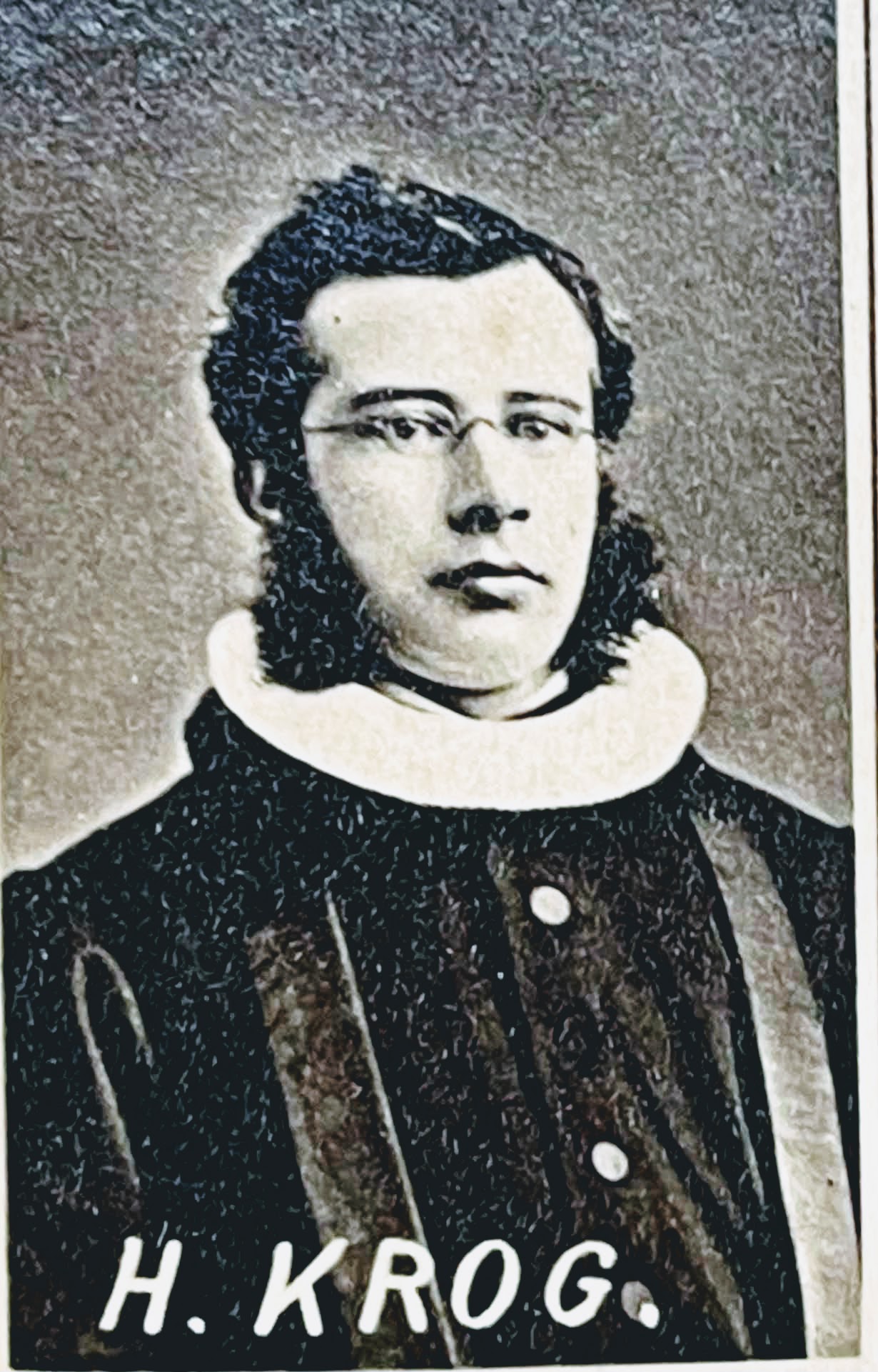
 Missionsvennen
Leave a comment