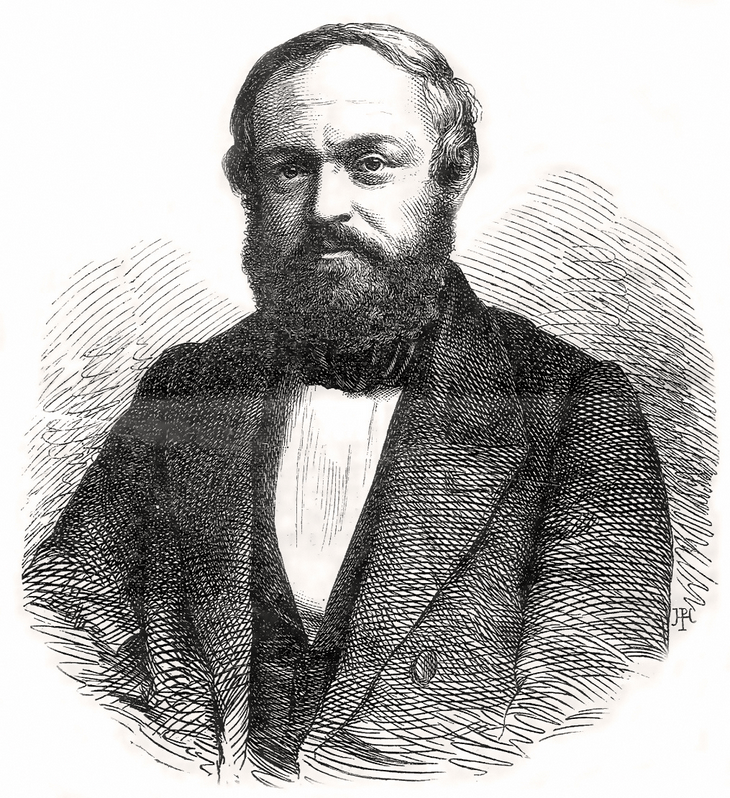
Translated from Store norske lexikon.
CR Unger was professor of Germanic and Romance philology at the University of Christiania from 1862. Together with i.a. Rudolf Keyser and PA Munch and later alone he published a number of Old Icelandic and Old Norse texts – royal sagas, romantic sagas translated from French and religious literature translated from Latin. The editions are based on Unger’s meticulous copies of the manuscripts.
Unger grew up in Christiania, but also spent two years (1830–32) in the house of the poet-priest Simon Olaus Wolff in Mo (now Tokke) in Telemark. He took the examen artium in 1835 and began to study philology, but never took the civil service exam (at that time mathematics, a subject Unger had a poor command of, was also compulsory for philologists). He followed Keyser’s lectures on Norwegian history and the Norse language, together with, among others, the 7-year-old PA Munch.
In 1841 Unger received a scholarship to continue working with Norse, Old English and Old German. He first traveled to Copenhagen, where he collected material for a dictionary of the Norse language from manuscripts in Det kgl. Library and the Arnamagnæan manuscript collection. He compared the texts in the manuscripts with the older text editions that existed, and discovered that the printed texts were often inaccurate in their reproduction of the manuscripts. He therefore wrote a number of saga manuscripts. From autumn 1843 to spring 1844 he studied in Paris, and from April 1844 he was in London; in both places he took copies of texts that had been the basis for translations into Norse. From the spring of 1845, Unger lectured on Norse texts and the Norse language at the University of Christiania, and he continued to do so until he retired shortly before his death in 1897. In 1851 he was appointed lecturer in Germanic and Romance philology, and in 1862 he became professor of the same subject.
In 1843, Unger had published a linguistic historical treatise, Beviser purat Atskillelse af de long og korte Voweler har finnd Sted i det gamle Norske , and in 1847 he together with PA Munch published the Old Norsk Læsebog with accompanying Glossary and Det oldnorske Sprogs or Norrønasprogets Grammatik . In the same year, Munch published a collection of fragments of manuscripts used for binding archive files, which national archivists CCA Lange og Unger had found in the National Archives. The same year also saw the first issue of the first volume of Diplomatarium Norvegicum , edited by Unger and Lange.
Unger continued to publish texts, i.a. the royal saga manuscript Flateyjarbók after the Icelander Guðbrandur Vigfússon’s transcripts, and he participated in the publication of the Diplomatariat up to and including volume 15, which was published after his death. From 1848 to 1877 he published text-critical editions of i.a. Alexander’s saga , Karlamagnus saga and the romantic tales Strengleikar , also Kongespeilet , Morkinskinna , the Bible translation Stjørn and the saint stories Thomas saga archbishop , Mariu saga , Postola sögur and Heilagra manna sögur , besides several manuscripts of the kings’ sagas. He supported Johan Fritzner’s dictionary work with contributions from his collections, and when Fritzner died before the third and last volume of the revised and greatly expanded edition of the work was ready for printing, Unger completed the work in 1896.
Unger was a member of Det Kongelige Norske Videnskabers Selskab from 1853 and of the Videnskabs-Selskabet in Christiania (now Det Norske Videnskaps-Akademi) from its foundation in 1857, as well as of several foreign learned societies. Together with Keyser, Munch, Sophus Bugge, Oluf Rygh, Siegwart Petersen and N. Nicolaysen, he founded Det norske Oldskriftsselskab (dissolved 1900) in 1861, which was responsible for many of his text editions. He was an honorary doctor at Lund University, and he was appointed knight of the Order of St. Olav in 1864, commander of the 2nd class in 1891 and commander of the 1st class in 1897.
Following an application, Unger was dismissed as professor in the summer of 1897, aged 80, and died in November of the same year. It is primarily as a text publisher that he has played an important role in the development of the subject of Norse philology, and many of his editions are still the only ones in existence.
Works
- French-English-German-Norwegian Parleur, containing a collection of easy conversations occurring in everyday life (sm.m. AJ Bergstrøm and PT Hanson), 1839 (3rd edition 1864)
- Evidence that separation of the long and short vowels has taken place in Old Norse , in Nor 2, 1841–43, p. 533–569
- The Grammar of the Old Norse Language or the Norrøna Language (sm.m. PA Munch), 1847
- Old Norse Reading Book with accompanying Glossary (sm.mds), 1847
- ed. J. Fritzner: Dictionary of the Old Norwegian Language, vol. 3, 1896
- Fagrskinna (sm.m. P. A. Munch), 1847
- Diplomatarium Norvegicum. Old Letters for Knowledge of Norway’s Internal and External Relations, Language, Clans, Seats, Legislation and Court Procedure in the Middle Ages , vol. 1–15 (vol. 1–5 sm.m. CCA Lange, vol. 6–16 sm.m. HJ Huitfeldt-Kaas), 1847–1900
- Alexander Saga , 1848
- Speculum regale. King’s shadow watch. Konge-Speilet (among R. Keyser and PA Munch), 148
- Olaf’s Saga hins heliga (Legendariske Olavs saga; sm.m. R. Keyser), 1849
- Strictness or Book of Poetry. En Samling af romantiske Fortællinger efter bretoniske Folkesange (sm.mds), 1850
- Barlaams ok Jehoshaphat Saga (sm.mds), 1851
- The saga of the King of Berne. Tale of King Thidrik of Bern and his Warriors , 1853
- Saga Olafs konungs ens helga (Snorre Sturlason’s Olaf the Saint’s saga; sm.m. PA Munch), 1853
- Karlamagnus Saga and his warrior , 1860
- Flateyjarbók (with Guðbrandur Vigfússon), 3 vols., 1860–68
- Management. Old Norse Bible History from the Creation of the World to the Babylonian Captivity , 1862
- Old Norwegian Homily Book , 1864
- Morkinskinna , 1867
- Heimskringla or Norges Kongesagaer by Snorre Sturlassøn , 1868
- Thomas saga archbishop. Tale of Thomas Becket, Archbishop of Canterbury , 1869
- Mario saga. Legends of the Virgin Mary and her Jertegn , 1871
- Codex Frisianus. A Collection of Norwegian King Sagas , 1871
- Konunga sögur. Sagas of Sverre and his Successors , 1873
- Postola saw clock. Legendary Tales of the Lives of the Apostles , 1874
- Heilagra manna sögur. Tales and Legends of Holy Men and Women , 2 vols., 1877
- A collection of letters and other personal papers can be found in RA (Privatarkiv no. 59)
- a collection of text copies can be found in the Manuscript Collection, NBO
Sources and literature
- NFL, bd. 6, 1908
- G. Høst Heyerdahl: biography in NBL1, vol. 17, 1975
- L. Holm-Olsen: Light on Norse culture. Norse studies in Norway, 1981


Leave a Reply