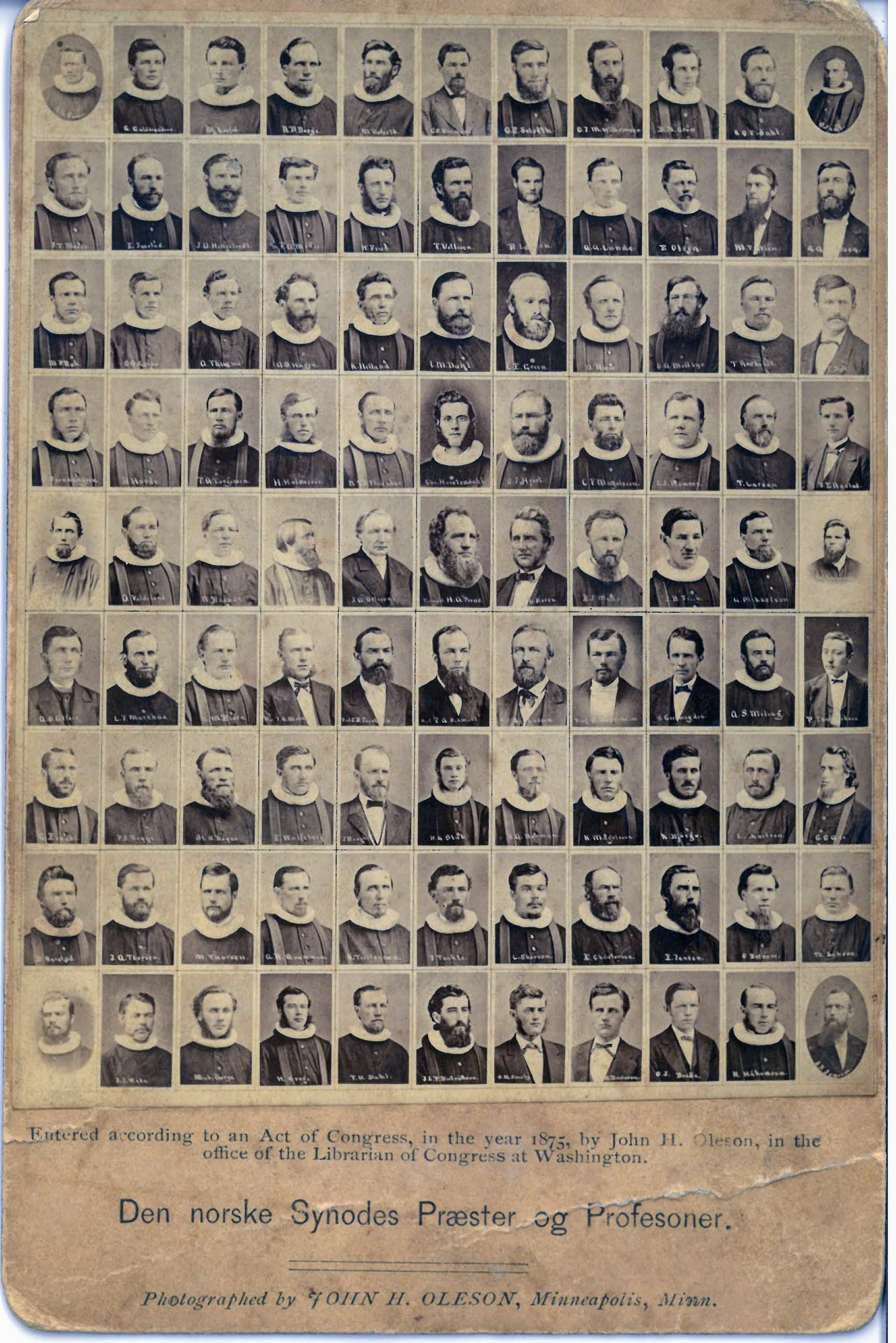
From Norwegian American Lutheranism Up To 1872 by J. Magnus Rohne, New York, MacMillan, 1926.

…the Synod pastors wore the Norwegian clerical garb. This consists of a black gown hanging straight from the shoulders to within a few inches of the floor. Over the gown is a stiffly padded, inch-wide, satin-covered stole, or “yoke,” which hangs around the neck and down both sides of the front the full length of the gown. This stole, or “yoke” was mistakenly taken to symbolize the complete surrender (“going under the yoke”) of the pastor to the sovereign will of God. At the back of the neck, the stole, or “yoke,” is raised somewhat so as to support the white fluted collar or ruff. The ruff, which is three inches wide and one inch thick, is worn Sir Walter Raleigh fashion, over the pastor’s ordinary wing collar, and symbolizes the purity and glory of the pastoral office. This white fluted collar with the black gown gives the pastor a worthy and dignified appearance when he approaches the Altar of God or preaches God’s Word from the pulpit. On the three major church festivals and on other very important occasions, the pastor wore a white surplice over the black gown. It is not until quite recently that the Oxford, the modified-Oxford, and the gown designed by a committee of pastors of the Eastern District of the Norwegian Lutheran Church of America have been regarded as proper pulpit gowns for the Norwegian Lutheran pastor.
The young couple had moved into Gunnar Haugen’s barn—but for a house! It rested on studs so that the cold wind rose up through the floor; you could see through the cracks in the walls. When the blizzards came, snow swept over their bed as they lay asleep. The peasants had tried to daub and seal the cracks as best they could, but it didn’t help much. Now the priest had the house covered with cardboard inside and clad with bark on the outside, and slammed boards between the studs at the bottom, but it was still as if his feet turned to ice when he sat still for a while. And then it was just this one room. Alas, how different from the dreams of the pleasant rectory!
She could not help it, but tears ran down the cheeks of the pastor’s wife as she went and did housework. How could she arrange things and make them feel at home out of this! They had used carpets to divide the room into three parts. Behind one rug stood their bed in a corner, behind the other was the pastor’s “study room,” that is, a small table in front of one window with a stool by it. The rest of the room was the living room, a small space around the stove that stood in the middle, where the lady when the priest was out, usually sat in mute despair with her legs up on the grate to get some heat.
In the beginning they intended to cook inside the farmer’s house and then carry the food across the farm if they did not want to eat in his living room; but as this was too desperately inconvenient, so she had the hallway outside the storehouse divided into a small room where a stove was set up. Of course there was no question of keeping a girl, and it was good because she always had something to take care of that distracted her thoughts, otherwise she would have gone mad. But the fine Miss Christian often sighed and had to stop to breathe every time she had to shake the heavy bedclothes or sweep the carpet. If there was only someone to talk to! The woman on the farm was kind and helpful and did not know how good she made it; but she could not speak of anything but hay, corn, cows, and pigs. Alas, she had not walked on Karl Johans Gate[i]—she had not been to the student balls, she had not seen a Laura Gundersen[ii]and Johannes Brun[iii] play, she had not thrown flowers at the king and received a nod from him in return.
At first the pastor’s wife was so overwhelmed by loneliness and the strange surroundings that she was actually afraid of being alone. She had also experienced her first thunderstorm. Lightning upon lightning flashed, it was as if the whole sky opened up with hundreds of flames of fire, hissing serpents of fire shot across the horizon, and it roared as if heaven and earth were collapsing. The pastor’s wife screamed loudly, she ran around like crazy, and at last she jumped down into Gunnar Haugen’s basement.
When her husband came home, she was quite pale. She threw herself on his neck and asked him to be allowed to join him on his travels; she dared not be alone anymore. She also got permission, but she soon had to give it up. These awful distances! And then rattle in the car on the uneven roads or where there were no roads at all. And when one had then shaken one’s life away or was frozen stiff, then had to enter the small, nasty, log-houses, where children’s clothes often hung for drying, and where the air was utterly suffocating. And then having to eat and sleep in this air! Many of the farmers here were also from settlements in Norway, where they had little regard for clean food, and it was almost impossible to taste their well-intentioned dishes, set out in black wooden trays.
She had often resented the farmer’s wives, who, when they came to her nest, clasped their hands in amazement at how nicely she had made it. She did not know if it was hypocrisy or what it was; but now, on the other hand, she understood it when she saw their own conditions. That a human being could endure such conditions! Small earthen holes in a hill, a wretched shed covered with black cardboard or a narrow log house where the clay fell out between the logs, and which was full of bedbugs and screaming, soiled kids. The same room to live in, cook in, and sleep in—it was a good deed, after all, that the doors were so far apart and went straight out to the prairie; thereby came then fresh air, but ah for a draft! It was enough to break down the strongest health! Could people really get used to it? It was almost to despise them, it was to sink down to the animal level. No, then her lonely chair in front of the oven at home with her legs on the oven rack was preferable.
Why had no one told her this before? Why had Cooper written about the gleaming lakes surrounded by impenetrable, secretive forests, filled with romantic Indians? Here there was not an Indian to be seen, just swampy plains full of ordinary Norwegians who were even more sloppily dressed than the sailors back home in Kristiania. Kristiania!—alas, to be the one who was there!—the one who could travel there today or tomorrow! Now the balls had begun—perhaps the first City Council Ball was over; she should have been there —where she should have danced—no, it was true she was not allowed to dance since she was engaged to a theologian—I wonder if her friends were still invited to Chocolate at Günther by the students or the cadets? Maybe Elisa Ring had inaugurated her light blue silk dress, which she sewed before she left?
She was awakened from her dreams by someone shouting “Hello!” outside the window. She leapt up. Out in the yard stood Gunnar Haugen with a bloody calfskin in his hand. “If Mrs. wanted some veal today, we just slaughtered it.”
The priest had summoned the church to a meeting there in his own room, as it was the largest that existed in the “City.” He was still filled with resentment at the shameful manner in which the conditions of the Letter of Call were fulfilled, or rather “not fulfilled.” He was upset by the eerie impressions he had received at the reception, and he had set out to read the text to the peasants. He paced up and down the floor and smoked a long pipe, pondering the speech, while the peasants gathered outside or struck a small trade in the shop below. The pastor’s wife sat pale and dull on a chair by the window. She had not yet recovered from the exertion after the journey; if one spoke to her suddenly, she became hot in the face and got tears in her eyes. She dreaded how the meeting would turn out. Then the peasants came up the stairs, she shook their sweaty hands one by one, some of the farmer’s wives had followed; they brought butter and eggs and some chickens for the young pastor’s wife, and they looked her kindly in the eyes. This first sign of love made her feel so well that she whispered in her husband’s ear, “Do not be too strict, Christian!”
The priest began his speech rather calmly: he told the details of his calling, the prospects he had as a theological candidate with the best character at home in the old country, the promises the old priest who got him to move over had given, and—so he broke loose. He described his arrival and what he had felt; he asked them if they had lied to him and deceived him with intent, or where did all their vows go? Not even a roof over your head, and now that winter was approaching; this Mr. Wilkens had informed him that he could not stay there for more than a week. What was their intention? Would they starve him to death? Freeze him to death? Or what did they want? No Church—no vicarage—no ability to do anything! Was it not for the fact that he had to stay here, he would have gone home tomorrow morning. He had expected to come to loving people who longed for the good of the Lord and would welcome him with open arms, and what did he find now? People who seemed indifferent to whether he had come there or not, and who let him fend for himself now that they had first lured him into the trap.
The speech made an extremely eerie impression on the peasants; they all looked at each other and at the man who was usually their spokesman at the meetings. Per stroked his chin and was spitting on the floor to the North, South, East and West, all signs that his thoughts were brewing. Finally he got up. “I think you’re too brave, Priest,” he said, “you take this so purely for the contrary. You must keep in mind that this came upon us unexpectedly, we did not know anything about it, but we know that if we have promised, we will keep it, you just have to be patient. The land lies there for you; it isn’t broken yet, but we will help you clear it as best we can, and we will build houses as soon as we can get timber planks and pay for them. When we wrote the Letter of Call, we did not know of the grasshopper, and we cannot help that our Lord sent this evil on us, you see. But we will gather everything we can for you, it must be certain. And so there’s one other thing I want to tell you Priest. You’ll get nowhere being stiff and haughty as the Priests in the old Land are, for here it is the Peasant who “rules,” you see, here we are in a free “country” you see, and the bondage we toiled in at home, it’s over in America you see. And here there is no cashbox out of which you are conveniently paid, here there is no old King or old Bishop who tells me to do so and so. It is me the farmer, who steers the ship here, you see, and if you do not want to go with us, then it will be worse to fire yourself, because then you will starve and sit on a bare mound. And then I will send you home, and you will be have to come up with the travel money yourself. But if you are kind and wise and behave well as a good priest should do, then I know that people are not worse here than in other cities, and they will all do well for you all, both great and small.” Per’s speech caused great happiness, the peasants nodded and laughed and said “it was true, as Per had said.”
The priest also felt a little ashamed, he admitted that he had been too hasty, and with fine words asked them to help him adjust a little, and made it obvious how desperate he was here in this foreign land, and unfamiliar with the language. Yes, they all knew about that from the time they had come here. The consultation ended with the priest being allowed to live in Gunnar Haugen’s storehouse for the winter, then they would fix it as best they could, and then see to getting a house as soon as there was any possibility of it.
After the meeting was over and the peasants left, the priest stood by the window for a good while and looked at them. Most of them drove into the pubs, those who did not want to were laughed at by the others; some already went out a little unsteady on their feet. “Now I understand the Synod,” muttered the priest—“these people need strict discipline—they must be governed with an iron scepter.”
Kristofer Janson was a Norwegian poet, author, and Unitarian. He spent many years in America working primarily in Minnesota. He wrote many stories about the immigrant experience, most of which have never been translated into English to my knowledge. One of these works is Saga of the Prairie (Præriens saga) which contains several short stories.
I have attempted to translate “A Horse-and-Buggy Priest” from this book because it shows some of the hardships that my great-grandfather went through as a priest for the Norwegian Synod. I do not know Norwegian, so I rely on Google Translate alongside Einar Haugen’s Norwegian English Dictionary, and take some liberties to clarify phrases. I would love for someone more equipped than I am to do this, but so far no one has done so.
I will post the story in parts:

“Horse-and-Buggy” Priest? What is a “Horse-and-Buggy” Priest? Yes, there is one who, partly for a living and partly in zeal for his calling, goes out far west between the settlers to bring them the food of the Spirit that he can offer; goes out where there are no railways, no roads, where you have to wade through bogs and rivers to get from hut to hut. A “Horse-and-Buggy” priest is one who, for this reason, has to spend half his life on the country road in his buggy, he roams there in rain and snow as well as in scorching sunshine, and when he has sown the health of his youth down there in the steaming, feverish swamps, he leaves there as poor as he came, for it is rare that he can get his wretched salary paid. One year there are grasshoppers there, another year a drought, the third year floods are there, there is always something that has been there which intervenes in the priest’s coffers. One can say what one wants about the Norwegian Lutheran Priests; one may have many objections to their letter-worship,[i]spiritlessness, and dog-like loyalty to hundreds of dogmas — one thing must also be admitted, however: they count among themselves many good, brave men who have neglected all considerations of the comfort of a civilized life and have gone into want and troubles without number to serve their Lord and Master according to the precepts of their society.
The Priest we are talking about here did not know what awaited him. He had just finished his exams at home, had been engaged for a long time, wanted to get married, and for that reason he then accepted one of the letters of call that an elderly American priest who had come to Norway to fish for graduates brought with him from various Norwegian Settlements. The summons told of many glories: there was a complete settlement, even a small town, one had its own post office, the incoming priest was to have so many acres of land and a rectory in addition to 600 dollars a year. His elder brother in the Lord could not adequately praise the place, though he himself had certainly not been there; he also depicted the great clergyman who was among the settlers with poignant colors, and then his younger brother’s heart was touched. He married and traveled over.
His young wife was a Christian maiden who had read many novels. She knew America mostly from Cooper’s Indian stories, and she expected to find Unkasser and Chingackgooker wandering between dreamy lakes. She had taken her current husband mostly because her parents thought they would make a good team and because he was a theologian. She admired him. She thought he was very learned and superior to her when he laid out for her the different dogmatic doctrines and about the difference between transubstantiation and consubstantiation.
Along the way, the young newlyweds built castles in the air around their future home. They wondered what the rectory looked like and the garden, how many cows and chickens they could keep. She was to drink so and so many pots of milk a day and become really thick and fat; for now she was of very weak health. They were to drive around together to their parishioners and be received everywhere with smiles and open arms. He had been told that the settlers there were mostly housewives from home, and he thought of them as humble and submissive as at home. He was to go among them as a father and give them comfort and counsel. However, these patriarchal dreams were uncomfortably interrupted when they got there. There was no gathering of curious faces at any rectory where the settlers thought themselves all prepared for their coming; because first there was no rectory and second, no one knew when the priest arrived.
The people had been greatly astonished when they heard that they should have a priest; they did not expect their call to succeed, and it is true to say that it was the board of the Synod more than the people themselves who had run this arrangement. The congregation had promised to build a rectory in case they got a priest—it was true—but they thought it would be soon enough when they got the priest, and so— the grasshoppers had been there this summer and ruined it for them, so that it was possible to build now in the autumn. The poor young man felt considerably cooled. He stared in despair from his emigrant carriage, with strained oxen; for the last part the railway was left open, and horses were another rarity there. He saw beyond a cold, damp landscape, sad in its monotony, a wild prairie where the coarse grass still half-withered, with some black spots here and there with a little hut on them, and then some yellow stumps of corn-leaves, which remained. Out on the horizon a black forest closed like an iron lattice for his prison, and here and there on the plain flashed some puddles, half small lake, half bog. A gray, unhealthy steam rose from them now towards evening. His wife lay ill under the sun canopy on the carriage, the journey had been too strenuous for her; she was too tired to see.
“Are we not coming to the house soon now, Christian?” She called out to him.
“But dear good people! You must get me a house!” shouted the pastor to the few of his church members who had happened to surround the carriage. They scratched their heads and whispered together. “It’s best you drive to the Post Office, so long, you’ll probably stay there tonight?” was finally the result of the consultation. “We have to follow up.”
They stopped outside a small house, painted white, built in the manner of the common American store, with a sign almost as big as half the wall of the house. The sign read: “M.R. Wilkens. Grocery-store and Post office. “Outside the door came a suffocating odor of spoiled fish and half-rotten vegetables, a corner of the shop next to the green soap barrel was divided into the post office. Two outbuildings and three other small houses adjoined this municipal building and made up the town mentioned in the Letter of Call.
After a long negotiation, during which the young lady lay shivering under her blankets while the priest sat on the wagon pole and waited, it was finally decided that they should be allowed to stay there for the time being. Mr. Wilkens turned out to be a tall and thin American with a goatee, he greeted them politely and spoke a whole lot which they did not understand. Then he shouted at his shop assistant, and the two of them began to haul out and carry their luggage. But when the newcomers finally stood in the deserted, cold room with three chairs and a sofa bench to be beaten out into a bed, with not a female being to take care of them, just a bachelor downstairs whose language they did not understand, a smell of rancid herring from the shop, and a desolate landscape outside wrapped in damp fog—yes—yes, then they looked at each other and burst into tears. Paradise was near.
[i]“…petty adherence to the wording of a text without regard to its spirit and meaning.” https://ordnet.dk/ods/ordbog?entry_id=60170095&query=Ulk
A page from the Ossian, Iowa congregation of the Hauge Synod. The pastor was Peder Severin Stenerson.

This page records a congregational meeting in 1900 as well as the tail end of the previous meeting. It says:
For the school committee for next year the following were elected, Knud Østerhus, Karl Karlson and Jakob Østerhus, this committee is responsible, together with P. S. Stenerson to negotiate with K. M. ‘J’. Mjånos, if this person is willing to hold “mothers-school” ((language class)) here for the same pay – $20.00 per month or a little ‘more’. The referendum was read and passed.
March 29 – 1900
As was previously decided, the Stavangers congregation met for the official congregational meeting on the 29th of March, 1900. The meeting was opened with prayer, bible verse readings and song. After this, Pastor Stenerson declared the meeting open for discussion regarding if the congregation should send any delegates to the next annual meeting. After some debate, the congregation decided to send some delegates to the annual meeting. Then the congregation unanimously voted to have new cedar shingles put on the roof. As well as, voted unanimously to paint the church, both the outside and the inside. Then a committee was chosen for the collection of money for materials, consisting of Ole ‘Krundsvig’, Ole ‘Aasterud’ and Knud Kleppe Jr. Additionally a committee was chosen to direct and have oversight of the repairs to the church, consisting of Pastor Stenerson, E. N. Evensen and T. N. Evenson.
The referendum was read and passed the same day.
T. N. Evenson.
Temporary Secretary

Theologian. Parents: Second Lieutenant, later Harbor Director Georg Daniel Barth Johnson (1794–1872; see NBL1, vol. 7) and Wilhelmine (“Mina”) Hanssen (1800–69). Married 31.10.1849 to Emilie (“Milla”) Helgine Sophie Dybwad (15.9.1825–14.2.1898), daughter of merchant Jacob Erasmus Dybwad (1792–1854) and Christiane Lange (1795–1885). Grandfather of Lauritz Johnson (1906–92); uncle of Johannes Johnson (1864–1916) and Gisle Carl Torsten Johnson (1876–1946); brother-in-law of Jacob Dybwad (1823–99).
Gisle Johnson was one of the 19th century’s most important Norwegian theologians – Lutheran-confessional, but at the same time characterized by a modern way of thinking. For over a century he worked at the Faculty of Theology in Kristiania, and he exercised great influence on the future priests. He co-founded the internal emissary in Norway and was for a long time one of its foremost leaders. With his preaching of penance, he left his strong mark on religious life in Norway from the 1850s.
Johnson was born in Fredrikshald, but grew up in Kristiansand, interrupted by two years (1832–34) in Lyngdal. In Kristiansand he went to the city’s cathedral school and graduated from there to the exam artium 1839. At home he received a harmonious Christian upbringing. Also important was his long-standing and close friendship with assistant professor Ole Christian Thistedahl, who led him into 17th-century Lutheran orthodoxy and a pietistic-colored scriptural theology rooted in classical education.
After artium, Johnson studied theology at the University of Christiania and became cand.theol. 1845. The following year he traveled to Germany with a scientific scholarship. He visited Berlin and Leipzig and found a suitable place of study in Erlangen, where he met the Lutheran-denominational experience theology (“Erlangen School”). After two years abroad, he returned to Christiania, where in 1849 he was appointed associate professor at the Faculty of Theology. In 1860 he became professor with responsibility for systematic theology. In 1855–74 he also taught pedagogy at the practical-theological seminary.
In the 1850s, the state church faced great challenges. The resignation of the priest G. A. Lammers (1856) and the establishment of a free church which eventually became Baptist, caused unrest. In the laity there was great dissatisfaction with the Grundtvigian priests. In 1851, Gisle Johnson also emerged as an uncompromising critic of Grundtvigianism. Its lack of sense of the exclusive authority of Scripture, its optimistic view of man and its cultural openness were for him incompatible with Lutheran doctrine and with the pietistic basic attitude he shared with the “awakened” lay people. The Church’s infant baptism was attacked by Baptists. Johnson responded with the book Nogle Ord om Barnedaaben (Some Words on Infant Baptism).
In 1855, Johnson initiated the founding of the Christiania Indremissionsforening. Social and spiritual distress necessitated internal emigration; it should be concentrated on edification, “soul care”, dissemination of edifying writings and diakonia – a supplement to the state church’s public service. From 1855 he held for a time Bible readings in Christiania with a large influx. Johnson broke social and cultural barriers when he became a popular preacher as a professor. The Pietist revival of the 1850s was named after him (the “Johnson Revival”). Priests who had sat under his catheter helped bring it to church life. An alliance was developed between the Orthodox-Pietist clergy (“Johnson priests”) and the people of the inner mission, which was to become significant well into the 20th century.
Johnson was behind the establishment of the Norwegian Lutheran Foundation (1868), a nationwide central body for internal mission work and the forerunner of the Norwegian Lutheran Internal Mission Society, which was established in 1891. He was also involved in the establishment of a number of institutions, such as. Diakonissehuset (1868), the first nursing school in Norway.
As a Lutheran-denominational theologian, Gisle Johnson had difficulties with the public lay sermon, which accompanied the inner mission. When the Lutheran Foundation’s unorthodox preachers preached publicly, it was clearly contrary to the confession, he believed. Johnson sought a solution to his so-called “distress principle”: When the church was in spiritual “distress,” the layman had to use his gift of grace to preach; but when and where it should happen, the lay preacher himself had to consider. In that sense, the Lutheran Foundation took no responsibility. When the Lutheran Foundation was transformed into the Home Mission Society in 1891, the “emergency principle” was abolished, and Johnson resigned from the leadership.
In the 1870s, Johnson gave up teaching systematic theology and took over dogma history instead. He was clearly burnt out. Nor did he seem able to meet the challenges of modern culture. During the constitutional struggle in the 1880s, he was behind the conservative appeal To the Friends of Christianity in Our Country, published in 1883 as a warning against political radicalism within the left movement. The appeal provoked violent reactions on a liberal and radical level. Even within the lay movement it did not gain general support; large parts of it parish to the party Venstre.
Scripture, the Reformation confessions, and Luther himself were the decisive authorities in Johnson’s “system.” But it rested on modern principles: The valid theology was rooted in the individual faith experience. The Lutheran teaching content could be internalized in the believer because it expressed the experience of faith in a comprehensive way. In this way, the experience also had a dogmatically correct content. He justified this method theologically-psychologically in his pissing (learning about the nature of faith). Struggle for pure Lutheran doctrine, preaching of revival and emphasis on personal piety were natural consequences of his principled theological position.
Johnson’s professional writing was rather limited. He influenced primarily through teaching and preaching. But he emphasized journalistic communication: in 1859 he started (together with CP Caspari and RT Nissen) Theological Journal of the Evangelical Lutheran Church in Norway and edited it until 1891. In 1863 he founded the Lutheran Church Gazette and was its editor until 1875, and In 1864–71 he published Gammelt og Nyt, a Journal of Enlightenment and Building for Lutheran Christians.
For the Grundtvigians and the spokesmen of liberalism, Gisle Johnson represented orthodox dogmatism and dark pietism, for the conservative clergy and the pietistic lay movement in the inner mission he was a “church leader”. He was a member of the Society of Sciences in Christiania (now the Norwegian Academy of Sciences) from its foundation in 1857 and of the Royal Society of Norwegian Sciences from the same year. He was knighted by St. Olav’s Order 1866 and received the Commander’s Cross of 1st Class 1882; In 1879 he was created an honorary doctor at the University of Copenhagen.

German-Norwegian theologian of Jewish descent. Parents: Merchant Joseph Caspari (died after 1861) and Rebekka Schwabe (died 1859). Married August 1849 to Marie Caroline Constance von Zezschwitz (3.10.1830–14.3.1918), daughter of President of the Court of Appeal Carl August von Zezschwitz and Constanze Friederike von Polenz. Father of Theodor Caspari (1853–1948).
Carl Paul Caspari was a professor of Old Testament theology at the University of Christiania for 35 years. In his younger years, he made important contributions to the study of the prophets. He was also an outstanding connoisseur of Oriental languages, and made a pioneering effort in researching the ancient baptisms and creeds. Next to Gisle Johnson, Caspari stands as the foremost representative of Lutheran Orthodoxy in Norway in the second half of the 19th century; each in their own way, they came to shape the church’s view and theological point of view in several generations of Norwegian priests and theological scholars.
When Caspari, as a newly appointed associate professor of theology, gave his inaugural lecture at the University of Christiania in January 1848, he was no small sensation. That a German Jew, an internationally known Orientalist, of all things should act as a spokesman and apologist for Lutheran pietism in Norway, was no less startling. “We [were] excited to hear a Lutheran theologian who, born and raised as a Jew and fanatical of his ancestral faith, at a mature age and standing on the heights of science, had been seized by the gospel he had hated as a Jew, and , as it was called, had studied to contest it, ”said one of the students who heard his first lecture (the later Minister of State Nils Hertzberg).
His story of conversion, as he himself told it, is, however, less dramatic, and for that time also not unique. The parents did not belong to the traditional, strongly church- and Christian-critical Talmudic Judaism, but rather to the Jewish Enlightenment movement, which had as its program to adapt Judaism to the Christian Enlightenment culture in Europe. At the University of Leipzig, where Caspari studied Oriental languages, his Jewish Enlightenment philosophy was met and challenged by a pietistic revival movement among his Christian classmates. He was now convinced that the Enlightenment’s human view was far too shallow. He had early acquired Kant’s life motto: “You can, because you must!”; now he realized that he just could not, and that the message of Christ’s vicarious suffering and death was the answer he needed. He was baptized in 1838, aged 24, and took “Paul” as his baptismal name. He was not alone in this conversion process; two of his siblings were baptized soon after, and among Jews who wholeheartedly joined the Enlightenment movement’s assimilation program, this process was not at all unusual.
As a Christian, Caspari also changed his academic career; he now studied theology, including in Berlin under the great conservative apologist E. W. Hengstenberg. Before this change of course, he had published an exercise book in Arabic for students (1838). He crowned his efforts as an Arabist with the publication of a large Arabic grammar in two volumes (1844 and 1848); this is still the basis for the most used handbook in the subject.
As an Old Testament researcher, Caspari worked closely with a former fellow student from Leipzig, Professor Franz Delitzsch (1813–90). The two developed an entire research program, which aimed to disprove the thesis put forward by W. de Wette (1780–1849) and JKW Vatke (1806–82): that the Mosaic Law did not originate from the time of Moses, but was written down just before and during the Babylonian exile in the 5th century BC. Consequently, the Law of Moses presupposes the prophets, not the other way around. This had far-reaching consequences for the view of Israel’s history and the Old Testament canon.
The main point of his counter-evidence had Caspari learned from Hengstenberg, but he developed it further with great philological accuracy and learning: Within the Old Testament canon it can be shown that the later books always presuppose and to some extent quote the previous ones. This means that the prophets in their books quote and presuppose the law of Moses. Virtually all of Caspari’s articles and books in the Old Testament field of study form sub-studies of this research program, which he also continued with after his transfer to Christiania in the late fall of 1847. But after a major book on the Prophet Micah (1852), his Old Testament research subsides; after that he gives most popular theological lectures on biblical figures, and repeats his Old Testament lectures to ever new cohort of students. This is because from 1851 he had devoted himself to a completely new scientific task, which eventually came to devour him completely.
It was not to refute Old Testament Bible critics that Caspari had been brought to the pulpit in Christiania, but to another task. The person who had visited him in Leipzig and persuaded him to apply for the vacant associate professor post in Christiania, was then a fellow, later Professor Gisle Johnson, and he had his own agenda, also for Caspari. Johnson needed his help to refute Grundtvig’s “incomparable Discovery” of 1825, namely that the most authentic words from the mouth of Christ – and thus the foundation of the church – are not the words of Jesus in the Gospels, but the creed at baptism. The risen Christ himself had, according to Grundtvig, communicated to the apostles the Apostles’ Creed word for word, and since then these “words of faith” had been handed down without the slightest change throughout the centuries.
Caspari began to disprove this purely historically, through an in-depth examination of the origins and history of the creed. In the years 1853-57 he was in a kind of research quarantine and published almost nothing. But then, from 1858, there was a steady stream of major and minor studies of the history of the creeds, in addition to a number of publications of source texts. Through these publications, Caspari founded the modern exploration of the history of confessions, and his German publications are constantly cited as fundamental in the field. He eventually became so caught up in his church history studies that he went beyond the history of confessions in the strict sense and published texts and studies in the general ancient church and medieval history. While at first he was very concerned with the controversy against Grundtvig, this was strongly toned down in his later years, and when liberal German theology in the 1870s and 1880s attacked the apostolic confession as an imperfect expression of the faith, Caspari ended up expressing his sympathy for Grundtvig’s affair.
Caspari was knighted by St. The Order of Olav in 1862 and became commander of the 1st class in 1876. He was also a knight of the Swedish Order of the North Star, and from 1849 a member of the Royal Norwegian Society of Sciences. In 1857 he co-founded the Science Society in Christiania (now the Norwegian Academy of Sciences), where he was president in 1873, and contributed diligently both in the academy’s meetings and in its publication series.
In addition to his work as an academic teacher for two or three generations of Norwegian priests – they remembered him as the eminent and spiritual lecturer – Carl Paul Caspari was from 1859 until his death active as a member of the Bible Society’s Central Committee, and he was the leading professional force in general worked to provide Norway with the first Norwegian translation of the Bible. In 1861 he co-founded the Central Committee for the Jewish Mission in Christiania, and was chairman of the committee from 1866 until his death in 1892.
This article was published in the Norwegian Biographical Lexicon, published 1999–2005. The article will not be updated. Newer articles can be found in Store norske leksikon.
Bishop. Parents: Prost Søren Bugge (1721–94; see NBL1, vol. 2) and Gidsken Edvardine Røring (1724–93). Married 26.10.1787 in Horbelev on Falster to Cathrine Magdalene Koch (29.9.1771–14.1.1869), daughter of parish priest Hans Peter Koch (died 1806) and Lucie Olsen. Father of Søren Bruun Bugge (1798–1886; see NBL1, vol. 2) and Frederik Moltke Bugge (1806–53); grandfather of Johannes Christian Piene (1832–1912).
Peter Olivarius Bugge is one of the most colorful personalities in Norwegian church life, with strong inner tensions in his mind. It is significant that he came to bear the nickname “bifrons” (lat., ‘The man with the two faces’). He flung himself around with jokes and jokes. “My jovial mood,” reads a letter from 1816, “hardly leaves me here in life, and then nature goes over the rebuke, and caution lies under the table.”
Bugge’s father, who was the merchant’s son from Christiania, had been seized by the Herrnhut teachings that reached the country in the 1740s, and he raised the children in the same spirit. After being a priest in Holt from 1750, he became a priest in Vanse on Lista in 1767, and the youngest son received his education here until he was 11 years old. Then he was sent to Bergen to go to school with principal Fr. Arentz, and here he lived with his uncle, Hans Wilhelm Bugge, who at that time was the head of a Herrnhut congregation in Bergen, and who even the first summer took the young Peter Olivarius to Herrnhut itself.
After four years of schooling in Bergen, he returned home and attended the cathedral school in Kristiansand for a year, and from here he graduated from the University of Copenhagen in 1782. He began to study theology and took all his exams (cand.theol. 1786, magister 1787) with best Grade. Brilliantly gifted as he was, he had the good fortune – he says himself – to be treated by his teachers more as a fellow student than as an apprentice.
When Rector D. G. Moldenhawer, on behalf of the university, called him parish priest in Skullelev in 1787, he could not say no, but he did not thrive in the Zealand village, and in 1790 he succeeded in being appointed his father’s successor as parish priest in Vanse. In the meantime, he wrote the work that in a way became the program of his life, the Betragtninger over de aarlige Søn- og Helligdags Evangelier tillige med et Anhang af Passions-Betragtninger (house postal Considerations of the Annual Gospels of the Sunday and Holidays as well as an Appendix of Passion Considerations) (1791). The postil was published as early as 1793 in German translation, and a Finnish translation from 1804 was published in several editions until the 1860s. It must also have been translated into Swedish and Dutch. Bugge did not have his name on the first edition; he knew full well that the book would not give him any honor among his friends of the educated class. It was a sharp attack on the rationalist preaching, which made Jesus’ teaching the pattern of human virtue. In sharp contrast to this work is his treatise from 1796, De perversitate humana morali (On the Moral Plain of Man), in which he rejects both original sin and the devil; the dissertation earned him the theological doctorate at the University of Göttingen in Germany.
In the years 1799–1804, Bugge was parish priest in Fredericia in East Jutland, and it is in many ways a new Bugge you meet here. He began publishing a new Danish translation of a number of New Testament writings, and was thus the first Norwegian in recent times to attempt a Bible translation. Both the translation and the remarks that were attached to it have the clear tendency to transfer the words of the testament to modern thought and speech, and the four writings he had published in the years 1799–1803 are closely connected with contemporary rationalist work, and formed a clear contrast. to his house post.
In 1803, it was decided that the diocese of Trondheim, which also included the whole of northern Norway, should be divided in two, and on December 30, Bugge was appointed bishop of the new diocese of Trondheim, which in addition to the county of Søndre and Nordre Trondheim also included Nordmøre and Romsdal. He was ordained a bishop (along with Johan Nordal Brun and Matthias Bonsach Krogh) at a large joint episcopal ordination in Our Lady’s Church in Copenhagen on May 10, 1804, and then traveled to Norway to take over his new position.
After Bugge came to Trondheim, he soon came into conflict with his closest associate, diocesan dean H. J. Wille, and with other prominent officials in the city, such as diocesan court justice Andreas Rogert and commanding general G. F. von Krogh. He also came into conflict with the chancellery, which i.a. led to the fact that he did not receive the Order of Dannebro at the great service of the Order in 1810 like the other Norwegian bishops or as priests in his own diocese. The only thing in the administration that he was interested in was the care of the poor, and in 1809 he founded a “Charitable Society” in Trondheim. The distress that followed the war years of 1807 unleashed the power of compassion that lived in him, but also the violent indignation that was so strong in him. With a bleeding heart he saw how poor peasants and homemakers had to suffer, and with resentment he turned to landlords and merchants, who abused the peasants and exploited the need for their own gain. Throughout his life, he continued to feel almost connected to the underclasses.
As vice-president (from 1804) in the Royal Norwegian Society of Sciences, Bugge came from 1806 in constant correspondence with its president, Prince Christian Frederik. After the prince came to Norway in the spring of 1813, Bugge sent him a detailed description of the political way of thinking in Nordafjell. Bugge did not attend the large deliberation meetings at Eidsvoll on 30 January and 16 February 1814 (the “notable meeting”). He had traveled in advance for the prince to Trondheim. But he preached in the cathedral on February 6 about the hope that religion bestowed in these turbulent times, and he turned the hope to the prince who now worked for the good of the people. Carsten Anker had wanted the prince to be proclaimed king in the cathedral, but when the prince came to Trondheim, the plan had already been abandoned. Bugge still greeted him in a company in the bishop’s manor with a tribute poem as King of Norway.
After the big man’s meeting at Eidsvoll, Prince Bugge encouraged people to prepare a draft constitution and then come to Christiania. In less than fourteen days he had finished the draft. But it did not succeed, and was in its entire structure a clear contrast to the constitution that was created at Eidsvoll. According to Bugge’s proposal, the National Assembly was to be a pure assembly of clergy, bourgeoisie and peasants. It would have no legislative authority and would also have a very limited granting authority.
At the invitation of Christian Frederik, Bugge lived at Eidsvoll as long as the National Assembly sat together. Bugge’s deed at Eidsvoll is unclear. Some claim that he was Christian Frederik’s spy. “My fire-arrows,” he writes in a letter, “wounded many; I knew that pretty well; but they were just about to be wounded, and thereby frighten away from many a canary that was intended. ” When Bugge on his way home traveled up through Gudbrandsdalen, he was, according to himself, greeted by the farmers as the “who had significantly contributed to us becoming true Norwegians and independent, and especially at the National Assembly strengthened many weak”. He was received “almost with swarming Joy”, and followed many miles by all kinds of people, “yes even by Ladies”. Before his departure from Eidsvoll, the newly elected king had appointed him president of the Science Society, a position he held until 1820.
In the parliamentary elections of 1815, Bugge was elected as the first representative of Trondheim. In parliament, he soon made a name for himself by his “demosthenic” eloquence. He was for a time vice president of both the Odelsting and the Storting and for a time also president of the Odelsting. He was a member of the nomination committee and gave the impetus to the appointment of standing committees. He fought for the establishment of a protocol committee and was himself a member of it from the very beginning. Of the other standing committees, he was a member of the church committee, and auxiliary committee no. 3, where he allegedly wrote the temporary national school law of April 1, 1816. But he did not like the work of the Storting, and never later tried to be re-elected.
It took time before Bugge waited for the new situation. As late as 1816 he wrote secret letters to Christian Frederik, whom he consistently referred to as “King” Christian, at the same time as he let his irony spread to Karl Johan, who in a letter from 1816: “I parlance French so it has good custom without almost being able to (sic) a Word. My Norwegian Fist is squeezed and pressed with all Southern sincerity; yes, sometimes the love goes so far that it manifests itself in kissing. I got 6 ditto in one day and feared for my chastity. … My wife, on the other hand, who received a visit to Thjem, retained her chastity without any such attack on her. Instead, she received a souvenir of a pair of earrings with diamonds. I intend to take these with me when I come home, for she has no holes in her ears, and the town must not be left unused. ”
Only once later did Bugge attract political attention. On September 7, 1818, he gave a speech in the cathedral in Trondheim in connection with Karl Johan’s coronation. Bugge rebuked the people’s boastful arrogance and its abuse of freedom, and he urged people to bow to God and the king. But his sermon provoked a storm of rage, because he gave Karl Johan the credit that freedom had been saved in 1814. In the evening, the windows of the bishop’s courtyard were smashed, and the newspapers were filled with blacksmiths. He who had been Karl Johan’s fierce opponent was now perceived as bilingual – in politics as before in religion. He had then also been appreciated with the Knight’s Cross of the Order of the North Star in 1815 and the rank of commander (ie Grand Cross) two years later.
The storm against Bugge’s coronation speech led to him never later falling back into the worship of rationalism. He soon began to gather a Herrnhut circle around him, and in 1819 he officially defended the Haugian lay preachers. When the peasants in the Storting in 1836 had received a majority for the repeal of the Conventical poster, Bugge was the only one of the bishops who spoke in favor of the repeal.
In his older days, Bugge was afflicted with poor health, and he was – after a reluctant application – resigned from the episcopate in 1842. Seven years later he died in Trondheim, 85 years old. By then he had already experienced seeing two of his sons installed as principals at the learned schools in Christiania and Trondheim.
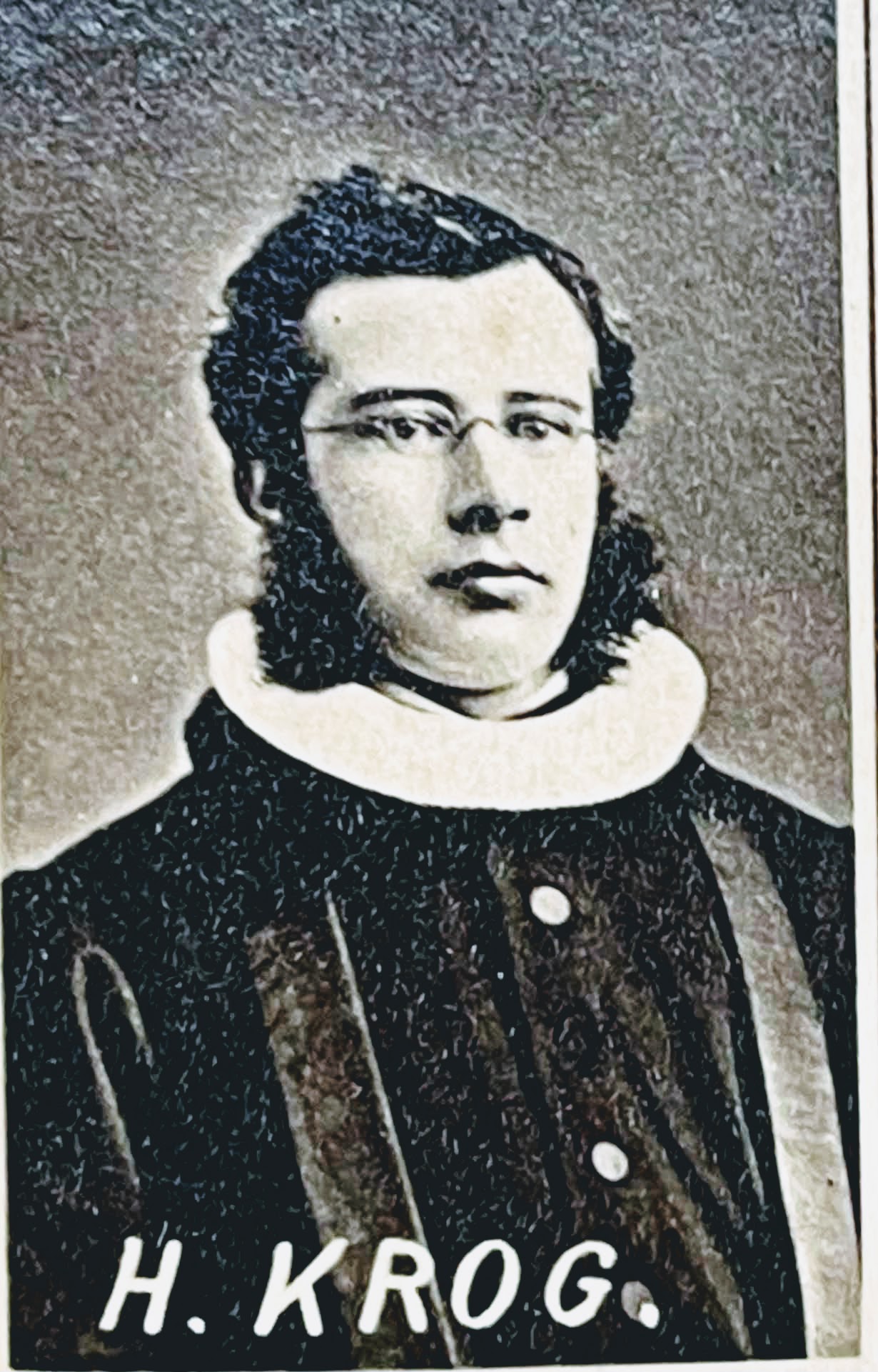
Hans Jakob Grøgaard Krog was born in Flekkefjord, Norway. After having obtained his master’s degree, he took up the study of theology but discontinued this, however, and became a teacher in Christiania and later in Trondhjem. Rev. J.A. Ottesen had often written in Norwegian papers concerning the scarcity of clergymen among Norwegians in America, and this led Krog to take up the study of theology anew. In 1872 he emigrated to America and was ordained into the ministry in 1874. His first call took him to Minneapolis, but a year later found him in Menominee, Wis., where he remained until 1890, when the Church Council elected him to a professorship at Luther College, where he remained for six years. He taught Norwegian, Religion, Latin, and French, besides taking, together with his wife, a very active part in the church work in and about Decorah. Rev. Krog was intensely interested in mission work, especially in the seamen’s mission. In 1902 he resigned his pastorate, which he had held at Ossian since 1896, in order to devote all his time to the mission work. In this capacity he labored unselfishly to the last. In the death of Rev. Krog the cause of Christian education has lost one of its warmest friends and supporters and one whose labors and influence have promoted and strengthened the highest and best elements in the field of education.
Designed with WordPress

 Missionsvennen